
West Seattle, Washington
25 Tuesday
The West Seattle low bridge amd northbound 1st Ave. S. Bridge are already scheduled for closure this weekend. We just got word of another closure starting Saturday and set to last at least a week – this is from Sound Transit:
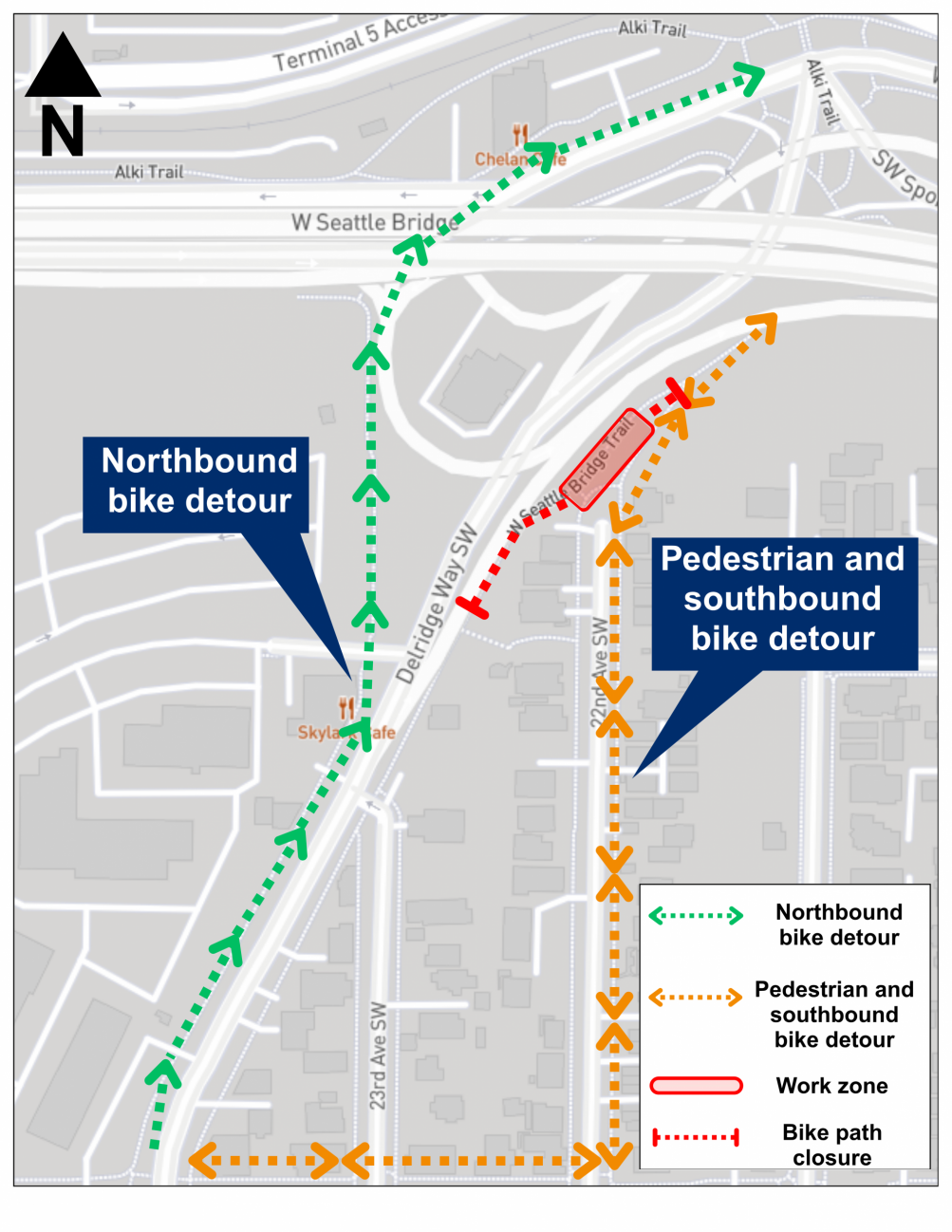
Beginning August 22, 2026, Sound Transit crews will conduct geotechnical work on the West Seattle Bridge bike path. Crews will drill a small-diameter hole and extract soil samples, then fill the hole and restore the surface area once the work is complete.
This work is expected to take about seven to eight days, and a portion of the bike path will be closed around-the-clock during that time. There will be a signed detour for pedestrians and cyclists in place. Please see the attached map for the detour route and closure area.
Nearby neighbors may hear construction noise during the daytime.
If you have any questions or comments, please contact the WSLE project team at westseattlelink@soundtransit.org or 206-903-7229. You can also contact the after-hours construction hotline at 888-298-2395.
This is in the path of the light-rail-only bridge that is to be built for the West Seattle extension – the complexity of which was cited as part of the reason the service is going to take three years longer than previously estimated, now set for a 2035 launch.
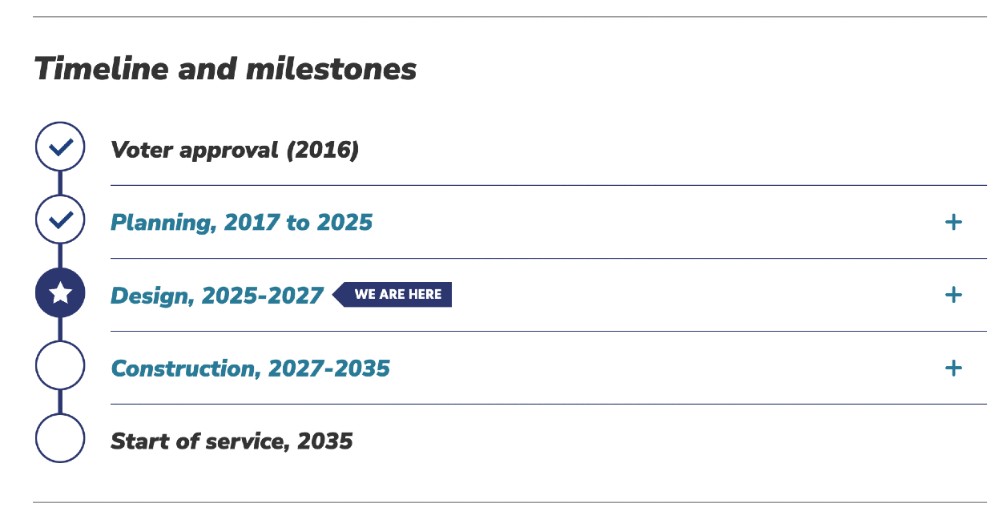 (New timeline, as reflected on Sound Transit website)
6:17 PM: Sound Transit dropped a bombshell during today’s meeting of its board’s System Expansion Committee – the opening date for the West Seattle Link Extension, long at 2032, is now delayed three years to 2035. Here’s how ST summarized it via email late today:
The West Seattle Link Extension is moving forward with an updated project schedule. Under the updated ST3 System Plan, the project remains fully funded and will advance toward construction. The anticipated opening date is now 2035, rather than 2032.
The updated timeline reflects both the cost-saving work completed to make the project affordable and refinements to the construction schedule. Concurrently, the project team continues to advance design and reduce community impacts. These efforts include a new SODO design solution that avoids significant utility relocations on 6th Avenue S., reflecting significant collaboration across Sound Transit, the City of Seattle, Seattle City Light, elected leaders, and community stakeholders.
We know many people have been eagerly anticipating light rail in West Seattle. We’re committed to delivering the project on a realistic timeline the agency can confidently stand behind.
We have more to report from today’s committee meeting and will add that soon.
ADDED 6:55 PM: The major West Seattle news on the committee agenda was originally – as we reported Tuesday night – proposed property acquisitions and a budget increase to pay for them (and other project costs). The presentation of those was when ST executive Brad Owen began the presentation, calling the West Seattle launch-date delay “difficult news to share,” describing it as an “unfortunate consequence as staff worked to identify an affordable path forward for the project, and as the board and the agency focused on addressing a nearly $35 billion gap in our long-range finance plan through the Enterprise Initiative.”
As part of the announcement, ST revealed the aforementioned new design plan for the SODO segment involving city high-voltage lines, as explained here, including:
The new SODO segment design will relocate major City infrastructure, Seattle City Light’s 230 kilovolt and 26 kilovolt transmission poles and lines, entirely within the light rail project footprint in the SODO Busway. This means that Sound Transit will not need to move massive powerlines onto 6th Ave S, which significantly reduces construction and lasting impacts on adjacent properties and businesses. The new design is expected to save the project over $100 million and remove the risk of damage to other critical City transportation and water infrastructure.
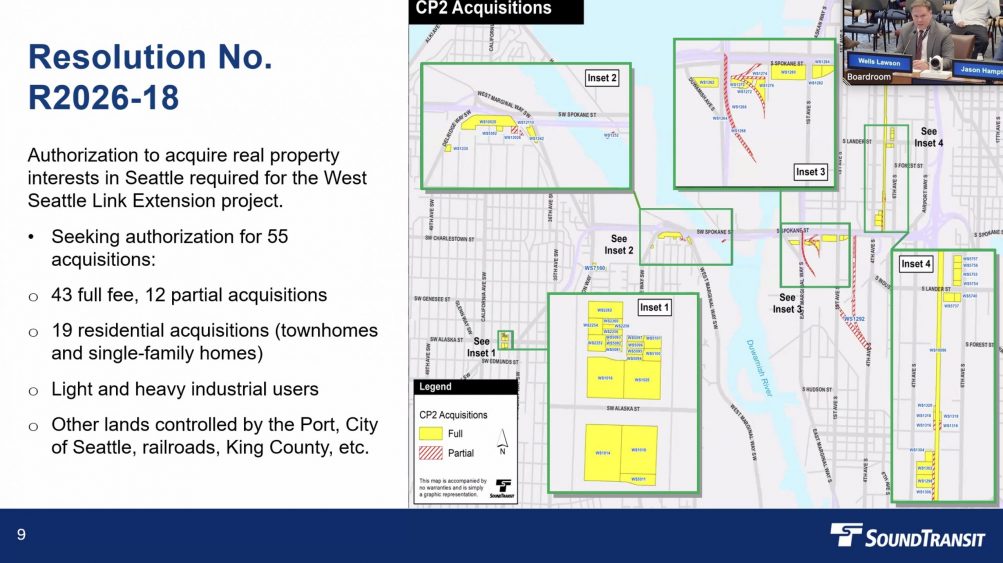
Presenting the 55 proposed property acquisitions – about half in SODO, half in West Seattle (all listed here) – ST managers told committee members they had used phone and email to contact all affected property owners to confirm they knew the plan was going to the board.
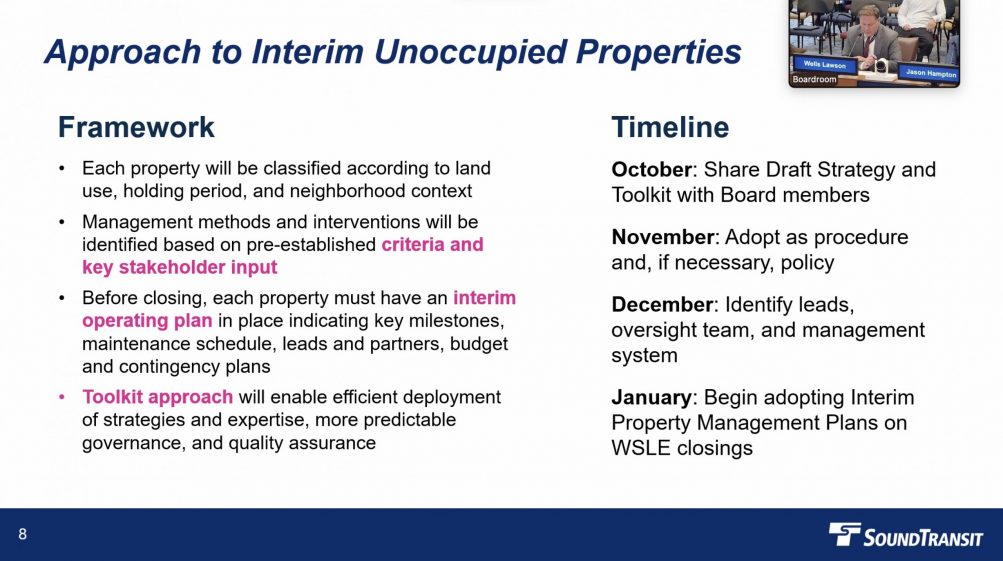
They also promised that they have a “vacant property strategy” so that none of the properties are unoccupied for more than a few months “before they’re actually needed for construction” and so that they “will not become burdens to the communities in which they are located.”
With a unanimous voice vote, committee members sent the plan to the full board, as they did with this companion resolution, a three-quarters-of-a-billion budget amendment to allow spending almost half a billion dollars for property acquisitions and another $300 million for “construction support services … through final design.”
Both resolutions will be up for a vote of the full board at its next meeting, August 27.
ADDED 8:45 PM: Two more notes – first, in a post elaborating on the email version of the schedule-delay announcement, ST blames part of the delay specifically on the cross-Duwamish-bridge part of the project. Second, for those trying to recall past timeline shifts, we checked our archives:
-2033 was what was originally proposed for the ST3 ballot measure
-2030 is what made it into the ballot measure
-2031 was the revision because of the pandemic
-2032 has been the date since the 2021 “realignment”
-2035 is the new projected WS date
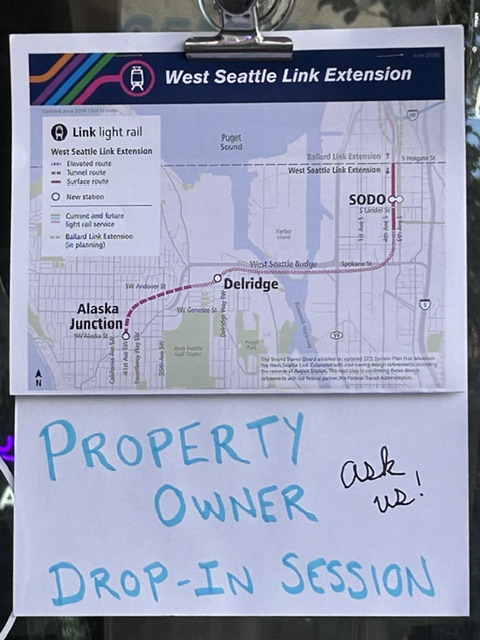
Story and photos by Jason Grotelueschen
Reporting for West Seattle Blog
Representatives from Sound Transit held an in-person drop-in forum on Tuesday night at Jet City Labs (4547 California Ave. SW) in The Junction, as part of the organization’s latest outreach efforts.
In particular, West Seattle Link Extension (WSLE) project team members from Community Engagement and Real Property were available to answer questions and speak directly with anyone affected by the upcoming ST Board vote about property acquisition. ST invited impacted property owners and community members to attend the event to learn more about the WSLE project, property acquisition efforts and the relocation process.
ST team members in attendance included Tanya Johnson, Rhonda Thomsen, and Scott Matetich, pictured left-to-right below speaking with neighbor Kelsey Johnold who is a homeowner near 41st and Alaska, which is one of the areas that will be significantly impacted by the current version of the WSLE project:
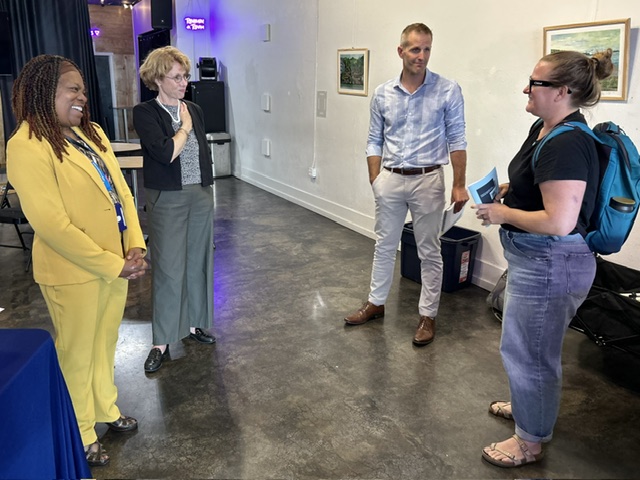
Johnold said that she wanted to take the opportunity to speak to the team, and to bring back literature and information for her neighbors who will also be impacted by the ST plans.
Also present from the ST team were Dani Schmidt and Hannah Rudin:
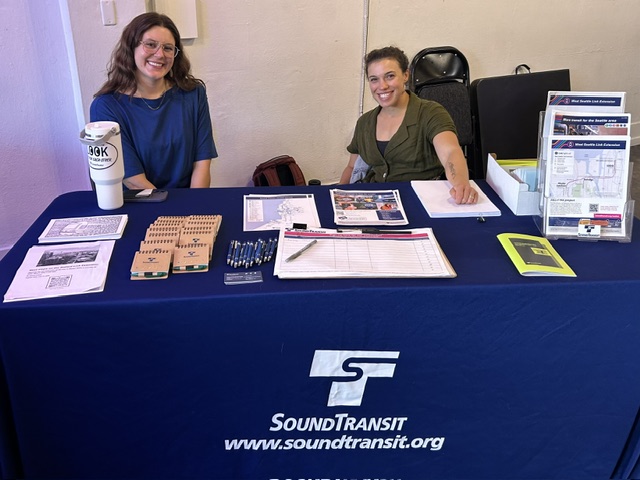
ST staff said the timing of Tuesday’s session was intentional, with ST’s System Expansion Committee meeting coming up Thursday (August 13), when 55 proposed property acquisitions will first be presented to ST Board. (They’re all listed here; about half are on the easternmost – SODO – stretch of the extension.) In late June, the ST Board approved a $400+ million spending installment for WS light rail (WSB coverage here).
The meeting was the first of four WSLE community events in August, with three others happening next week including an in-person event in SODO on Aug. 18th, and virtual events on the 19th and 20th. (Thanks to reader Bill for the last-minute tip on tonight’s meeting.)
Three things to tell you about West Seattle light rail tonight:
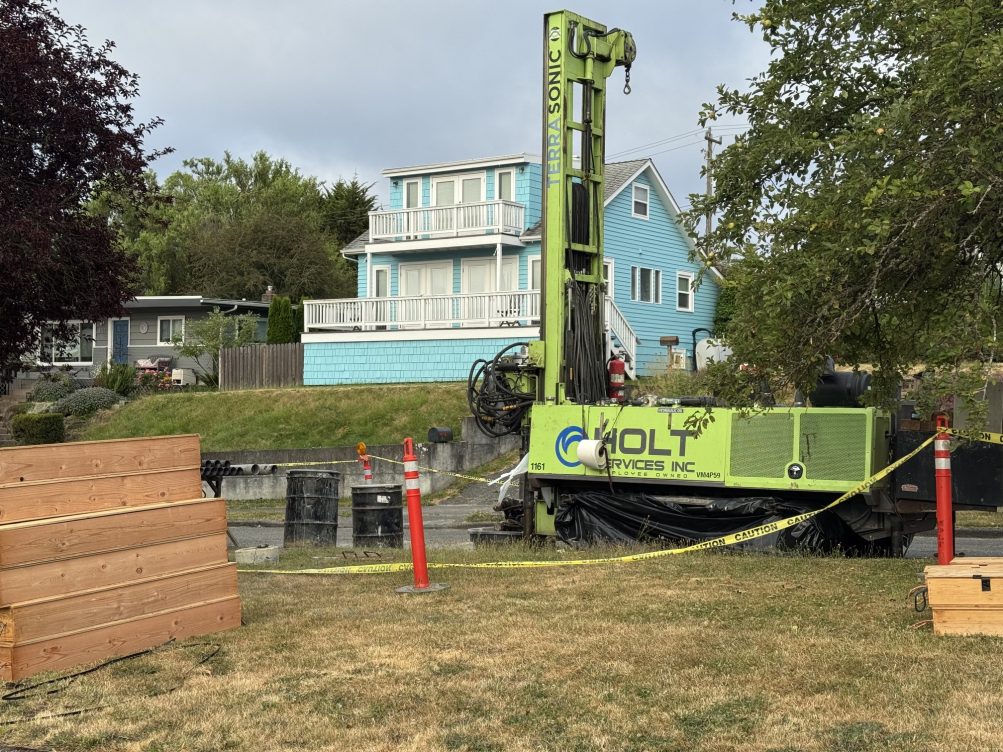
MORE DRILLING: Thanks to Kevin Freitas for the photo of a drill rig on 39th SW between SW Dakota and SW Genesee. Sound Transit spokesperson Amy Enbysk confirms it’s theirs, spending about a week in the area doing soil sampling and installing a groundwate monitor. Here’s the official notice distributed nearby.
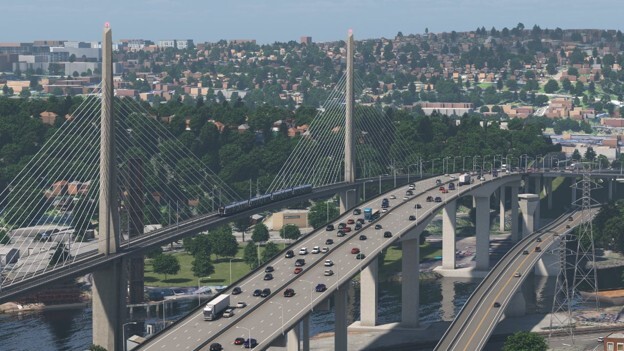 (Sound Transit rendering)
BRIDGE BIDDING: Community comments at today’s Sound Transit Board meeting shone light on the fact that Sound Transit has a “request for qualifications”u out right now for potential bidders to build the new light-rail-only bridge across the Duwamish River that the West Seattle Link Extension project requires. The deadline for submissions is next Tuesday, July 28. At least one analysis says the contract could be worth up to $900 million.
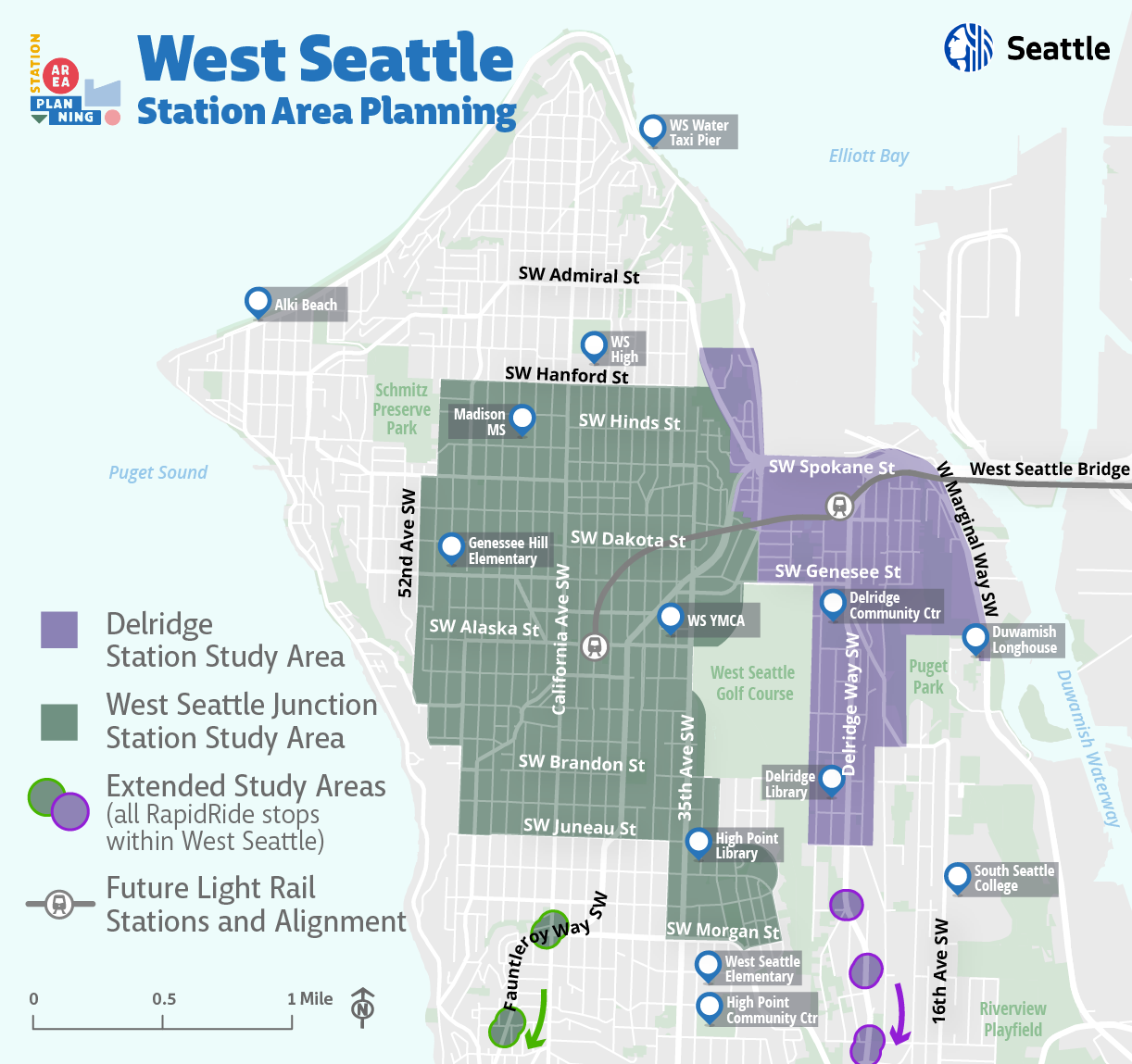
NEW SURVEY ABOUT NEIGHBORHOODS: A tip late today pointed out a new West Seattle light-rail-related survey just launched by SDOT and the city Office of Planning and Community Development. This one is about neighborhood planning, somewhat related to light-rail station areas (remember West Seattle now has only two, Delridge and The Junction) but also beyond – see the map above. However, it’s not about what the stations themselves should look like. Find the survey here. It’s open through the end of August. You can also offer opinions and ask questions at the city’s booth at the next two West Seattle Farmers’ Markets (July 26 and August 2).
Two weeks ago, we reported on the Sound Transit Board‘s System Expansion Committee recommending approval of actions to allot $406 million toward West Seattle light rail – the first big commitment after the ST3 plan revision that cemented ST commitment to WS. At this afternoon’s meeting of the full board, the actions all got final approval, as did a much-smaller installment of spending on Ballard light-rail planning.
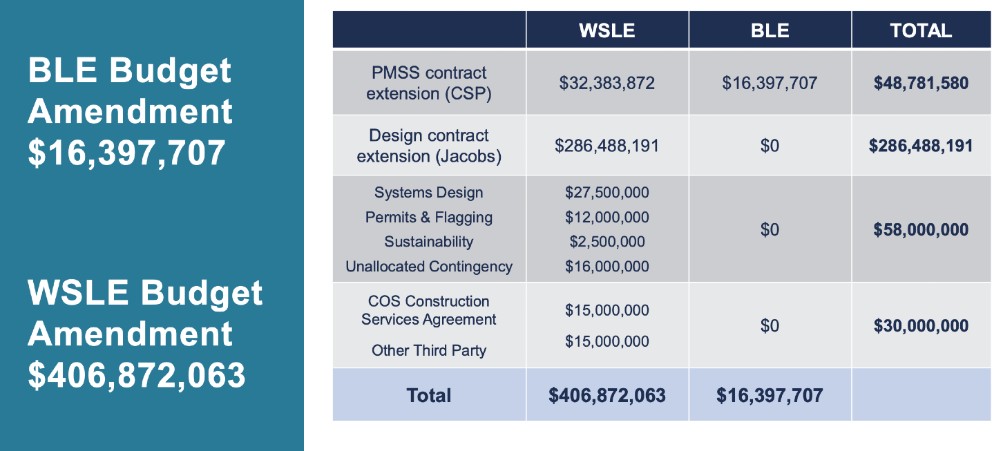
(Here’s the full slide deck as presented at the committee meeting, also including the current WS light-rail cost estimate of around $5 billion.)
On the horizon, according to the most-recent ST email update, is work to advance the plan for the new cross-Duwamish River light-rail bridge, shown in this rendering:
(Sound Transit rendering)
That work on the south end of Harbor Island (in a parking lot at 1001 Klickitat, according to city docs) will see crews drill a test bridge shaft approximately 10 feet wide and 250 feet deep to better understand ground conditions,” ST says, to obtain “key information needed to finalize the bridge design.”
 After the Sound Transit board passed a revised ST3 system plan two weeks ago, including a commitment to build West Seattle light rail as planned – minus the Avalon station – the agency said “a flurry of activity” would follow. Today brought evidence of that – the board’s
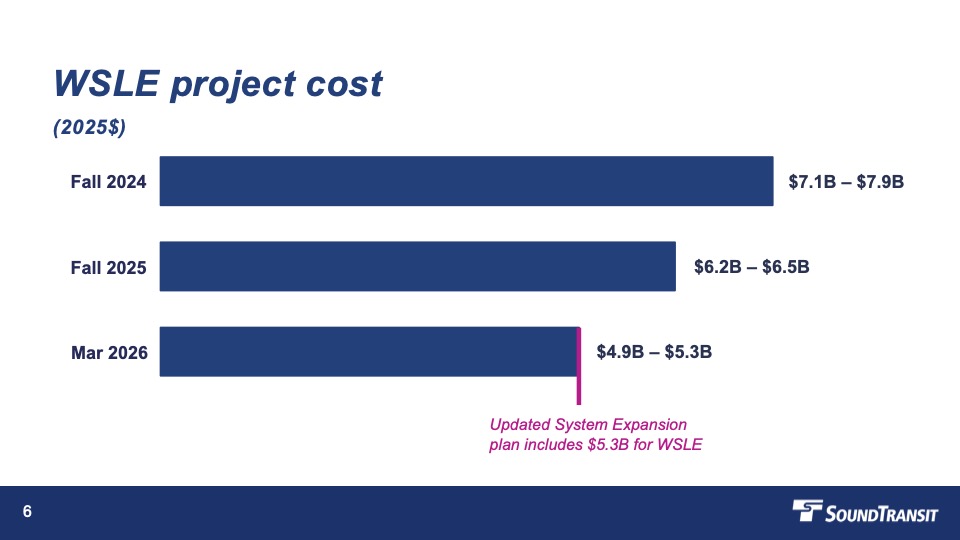
 Executive Committee System Expansion Committee voted this afternoon in favor of motions committing more than $400 million to the ext stage of the project, primarily to advance design past the current 30 percent level. A large part of the allocation was described as being for “supplementing” ST’s own staff, though it was promised that if in-house staff became available, they’d be used instead. ST’s Brad Owen – whose role has just been elevated with the impending departure of deputy CEO of megaprojects Terri Mestas – also told the committee that “cost-saving work continues” and the current estimated price tag of the West Seattle extension is $4.9 billion to $5.3 billion, as shown on this slide:
SEE THE DETAILS: The slide deck from this part of today’s meeting is here; the motions that got committee support today are here, here, and here. They’ll go to the full board in two weeks.
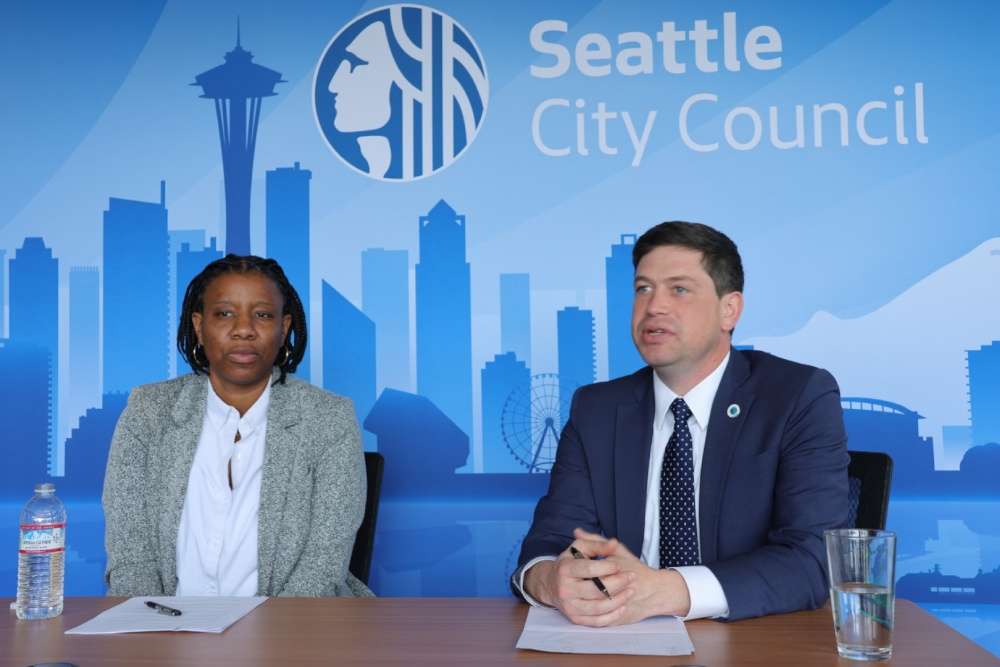 (WSB photo: Councilmember Dan Strauss with Council President Joy Hollingsworth at this morning’s Q&A)
Also in attendance at today’s informal periodic city councilmember Q&A session with reporters (earlier coverage here) was Councilmember Dan Strauss, who is the lone Seattle councilmember also on the Sound Transit Board. After the board vote a week and a half ago to approve a revised ST3 plan that does not include funding to get light rail to Ballard – which was part of what voters passed a decade ago – there were suggestions that Seattle voters who wanted more than the new plan might want to consider raising the needed money themselves. We asked Strauss his thoughts on the idea. “Inappropriate at best,” he replied, considering Seattle residents have been paying for a “Sound Transit project already promised.” He said he continues to believe that the second downtown tunnel could be dropped from the plan to clear enough funding to build all the way to Ballard. “We need to have a deeper conversation about that,” he said, adding that he considers the tunnel a regional amenity for ST, not a feature necessary to complete light rail in Seattle.
SIDE NOTE: Strauss and Council President Joy Hollingsworth also were asked about another transit-funding issue, Mayor Katie Wilson‘s proposed doubling of the sales tax that buys more Metro service for Seattle. Both said they have “concerns” about how the revenue would be apportioned.
By Tracy Record
West Seattle Blog editor
Just concluded, after almost six hours, a marathon Sound Transit Board meeting centered on revising the ST3 plan.
Biggest headline for our area: West Seattle light rail, minus the Avalon station, moves forward, remaining on the “what’s affordable” list. There was little discussion or mention of West Seattle as the board went through the proposal and 13 amendments; perhaps the biggest news was board members unanimously committing to figuring out how to get light rail all the way to Ballard. “The math doesn’t work today but we’ll make it work,” was a statement from Pierce County board member Hunter George that summarized how that was going to happen, somehow. The transformation of West Seattle into a project considered “affordable” was held up as an example for what might be done to “make it work” for Ballard; George blurted that there was a time when he thought “West Seattle was cooked,” until various cuts and changes were made as part of what became known as ST’s Enterprise Initiative. ST’s Brad Owen noted that it took a full year of work to come up with those cuts and changes, and that the work came after a milestone in the WS project – the Record of Decision – that Ballard has not yet reached. Nonetheless, the commitment to Ballard was significant, acknowledged board member and Ballard-area Seattle City Councilmember Dan Strauss, who said he came to the meeting thinking he wouldn’t get that support. He got support not only for ensuring ST3 gets to Ballard, but also for setting a date for it, even though any date would be “unreliable,” staff warned, until the project is “baselined” in three years or so.
In closing comments, board member and King County Executive Girmay Zahilay noted this is basically the green light for West Seattle light rail, then turning to the lone West Seattleite on the board, County Councilmember Teresa Mosqueda, and asking, “Are you excited?” In her own remarks a few minutes later, Mosqueda noted that what’s happened so far was “no easy task” but also noted “this shows we are not powerless in the face of challenges. She called for “rolling up sleeves” and advancing work on West Seattle as well as other projects (board chair and Snohomish County Executive Dave Somers said WS is at 30 percent design).
Money challenges remain, in fact, and one amendment, by board member and Seattle Mayor Katie Wilson, reflected that; she wanted work to start on a “new revenue package.” Some other board members said it was too soon, and that ST has enough of a trust problem that it wouldn’t be right to ask people “to pay more for what they’ve already paid for.” The proposal had the option of a “sub-area-only” proposal, and a few non-Seattle board members said that if Seattle (or some other area) wanted to tax itself further for this, “go for it.”
But that discussion will be for another day, probably even some other year.
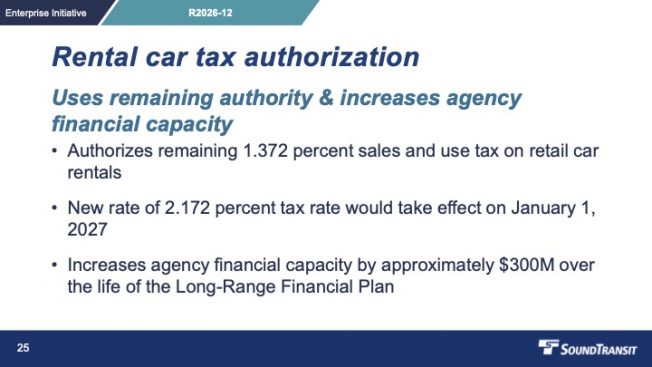
As part of today’s activity, the board is using pre-approved taxing authority, maxing out a rental-car tax to raise $300 million more.
Overall, though, “The real hard work begins now,” declared Somers just before the final vote on the amended resolution, which was 16 yes, 2 no (Strauss, who said it still hadn’t gone as far as he needed it to, and Bellevue board member Claudia Balducci, who said she thought it needed more work.) “We are excited to finally move forward,” said ST CEO (and West Seattleite) Dow Constantine after the vote.
ADDED 8:35 PM: Board members are sending out statements. From Councilmember Mosqueda, this passage specific to WS:
… For West Seattle, this vote makes it possible to officially initiate early pre-construction work, such as geotechnical testing like drilling to test soil stability for the bridge foundation and contracting with critical engineering and design consultants, laying the groundwork for us to be able to build the promised light rail in the near future. West Seattle light rail expansion is now poised to enter a new phase of project development, made possible by cost savings work done by Sound Transit that has already yielded nearly $2.6 billion in savings while retaining ridership and avoiding impacts on many businesses and residential properties. …
ADDED 9:46 PM – WHAT’S NEXT? We asked Councilmember Mosqueda and chief of staff Erin House, who the councilmember described as immersed in ST matters, “what’s next?”
Today’s vote included funding for West Seattle design and construction in the 20-year plan, which enables the Board to authorize more specific steps authorizing expenditures in the coming weeks and months, including:
June
· Contract extensions for engineering, project management, and final design:
o Contract extension and budget authority for Engineering Design Services (EDS) final design (approximately $300M)
o Contract extension and budget authority for Project Management Support Services (approximately $35M)
o Budget authority for the project’s sustainability cost allocation (approximately $20M)
o Budget authority for miscellaneous final design costs (approximately $7M)July
· Budget authority for property acquisition, construction services agreement with City of Seattle, and permit fees:
o Budget authority for real property acquisitions (approximately $380M)
o Construction services agreement with the City of Seattle (approximately $15M)
o Third-party coordination, include City of Seattle permit fees (approximately $9M)September
· Contract extensions for engineering and design services
o Contract extension for systems-related EDS (approximately $27M)October
· Budget authority for real property acquisitions (approximately $90M)
7:02 PM: After two Executive Committee meetings this month looking at a proposed revised plan, the full Sound Transit Board is scheduled to consider ST3’s future tomorrow afternoon, almost 10 years after voters passed the original plan. As previously reported, the revised plan as discussed so far would proceed with West Seattle light rail, running between SODO and The Junction with a new cross-Duwamish bridge and a Delridge stop along the way. Documents for tomorrow’s 1:30 to 5 pm meeting, including the agenda and board members’ proposed amendments, are all linked from this page, including the amendments as a single document. The meeting will start with a public-comment period; the agenda explains how to comment in person at the board room downtown or remotely.
ADDED 10:21 PM: Speaking of comments – ST also released a report on the “engagement” related to the Enterprise Initiative, which shaped the revision proposal. You can read it here. The longest passage related to West Seattle is on page 18:
… Sentiments surrounding the West Seattle Link Extension highlight a mix of shifting priorities and ongoing anxieties. Small businesses and property owners — engaged directly and through groups like the West Seattle Chamber, the West Seattle Junction Association, and the SODO Business Improvement Area — responded favorably to a cost-saving alignment presented in March. In April, Boardmember Mosqueda hosted a community forum where community expressed significant support for the West Seattle Link Extension. While a vocal contingent argued the project is too expensive for its projected ridership — suggesting it should be delayed to prioritize the system’s spine or replaced entirely with bus rapid transit — there has also been a positive shift among local stakeholders.
This alignment successfully reduced effects on businesses and community assets, leading to increased local support for the extension. Nevertheless, even among these supportive groups, there is lingering frustration with the ongoing delays, uncertainty, and the project’s complex construction logistics. …
The Sound Transit Board‘s Executive Committee didn’t vote this afternoon on an ST revision after all, but the push is still on for a full board vote two weeks from today. The board’s chair, Snohomish County executive Dave Somers, said a vote wouldn’t be appropriate because too many amendments had either been, or were expected to be, proposed.
This afternoon’s discussion did shine more light on issues brought up by board members at their regular monthly meeting last week. For example – why are they updating the plan now? ST’s Alex Krieg said the ST3 plan approved by voters in 2016 required a plan update when the plan is out of alignment with the available funding, and they’ve certainly arrived at that point. They can afford $57 billion worth of projects, both fully and partly funded, and West Seattle light rail – currently priced, even without the Avalon station, at $6.8 billion – would be on the fully funded list. But unless they adopted a complete new plan, they wouldn’t be allowed to spend all the money they’d need to spend to get West Seattle on the track to completion.
Krieg insisted that the proposed revision doesn’t cancel or eliminate anything, and there’s still room and time to add things back – like the Ballard Link Extension, for example, with a price tag of $7 billion to $9 billion for the segment from Seattle Center to Market Street, which is left hanging in the proposed revision. Though he’s not on the Executive Committee, board member Dan Strauss – who represents Ballard on the City Council – was there to say he won’t settle for that. And Mayor Katie Wilson, a board member who is on the committee, said she wanted to at least see a date for when they envisioned completing Ballard in this revision. (Theoretically West Seattle, “fully funded,” is still on track for 2032 completion, although board chair Somers took issue at one point with the frequent usage of “shovel-ready” to describe it, saying “major construction” actually wouldn’t start until 2028.)
One date of note: CFO Hughey Newsom noted that the revision would extend the end date of ST3 financing from 2046 to 2052.
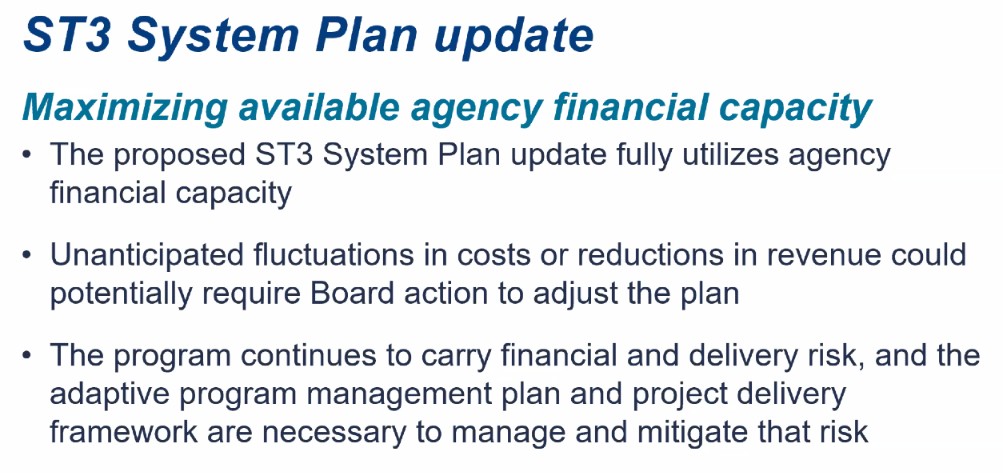
And he pointed out that the revised plan would totally max out their expected financing – not counting a 10 percent so any change in costs, for example, could throw it “out of alignment” again and require yet another revision.
In board comments, committee member Ryan Mello, Pierce County Executive, declared the board needs to take action – “delay will only add cost and risk and is not our friend.”
King County Executive Girmay Zahilay, also a committee member, said he supports a vote at the May 28 board meeting too.
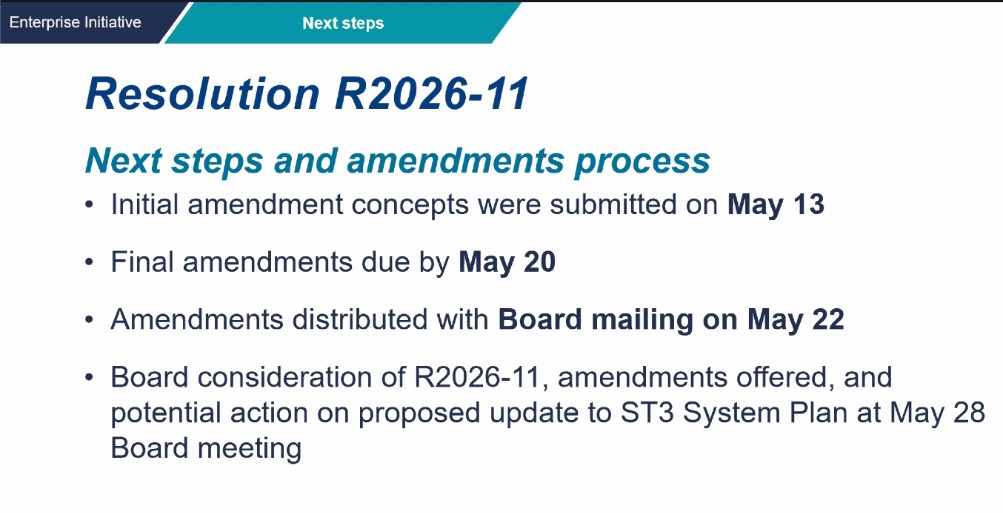
Along the way, Somers pointed out that even a vote on this ST3 revision is not a final commitment to West Seattle or any other project – those would be separate votes. So here’s what happens next:
Tomorrow (Thursday, May 14) is another pivotal day for Sound Transit decisionmaking regarding West Seattle light rail (and other projects). The ST Board’s Executive Committee is having a special meeting one week after it was presented with a proposal to revise the ST3 plan, given its huge financial shortfall. The list of what would proceed if this proposal goes forward includes the West Seattle Link Extension minus the Avalon station – here’s the “fully funded” list from tomorrow’s proposed resolution:
Fully funded projects
Tacoma Dome Access Improvements
West Seattle Link (no Avalon Station)
Tacoma Dome Link
Everett Link, phase 1
Ballard Link initial segment (Seattle Center)
Everett Link, phase 2
T Line to Tacoma Community College (now 2043)*
South Kirkland to Issaquah Link (now 2050)*
Link Operations and Maintenance Facility South
Link Operations and Maintenance Facility North
Sounder Maintenance Base
The other ST3 projects wouldn’t necessarily be dead, but some are proposed to move forward “partially” while others would be indefinitely “deferred” and yet others would be labeled “not currently affordable.” The Executive Committee may vote tomorrow to move the proposal to the full board, which meets May 28; it’s taking public comment at the start of the 1:30 pm meeting, in person and online, as explained on the agenda. The only Seattle rep on this committee, by the way, is Mayor Katie Wilson.
With major decisionmaking just months or maybe even weeks away, Sound Transit has just launched a survey asking for your priorities regarding what to do next as it tries to close a $34 billion shortfall while keeping promises. Here’s how its announcement explains the survey’s goals:
Sound Transit is working to reduce the impact of historic inflation, tariffs, labor shortages, supply chain disruptions and other factors on its ability to plan, build and deliver transit to the region.
The agency currently estimates that it will need to close a $34.5 billion funding gap over the next 20 years to deliver what’s outlined in the voter-approved Sound Transit 3 program. ST3 includes light rail extensions to West Seattle, Ballard, Tacoma, and Everett, South Kirkland and Issaquah, and much more.
Sound Transit’s Board of Directors and Sound Transit staff are taking proactive steps to address this long-term financial challenge through a comprehensive agencywide process known as the Enterprise Initiative (learn more about that initiative here). As part of this process, the agency is requesting feedback via a survey from those who live within the Sound Transit District.
This survey is available here.
To catch up on WSB coverage of the West Seattle light-rail plan, scroll this archive.
SIDE NOTE, ADDED SATURDAY: Possibly of historical interest: While reviewing long-ago coverage for a KUOW interview we recorded Friday, we happened onto these ST survey results from 2015, one year before ST3 went to voters.
 (WSB photos and video)
By Tracy Record
West Seattle Blog editor
The atmosphere was relentlessly upbeat at tonight’s overflow-crowd West Seattle light-rail forum, organized by King County Councilmember, Sound Transit Board member, and North Delridge resident Teresa Mosqueda as a sequel to the one she presented last November.
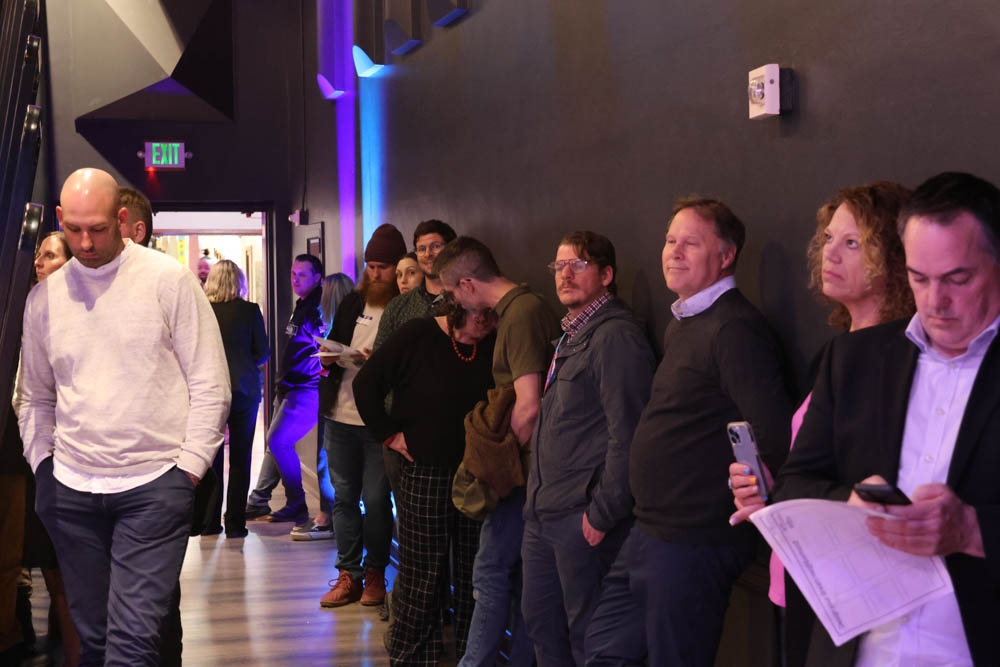
Last time, the beef was that there wasn’t enough time for Q&A, so she promised at the outset tonight that her two-hour event would allot fully half the time to that – and that’s exactly what happened.
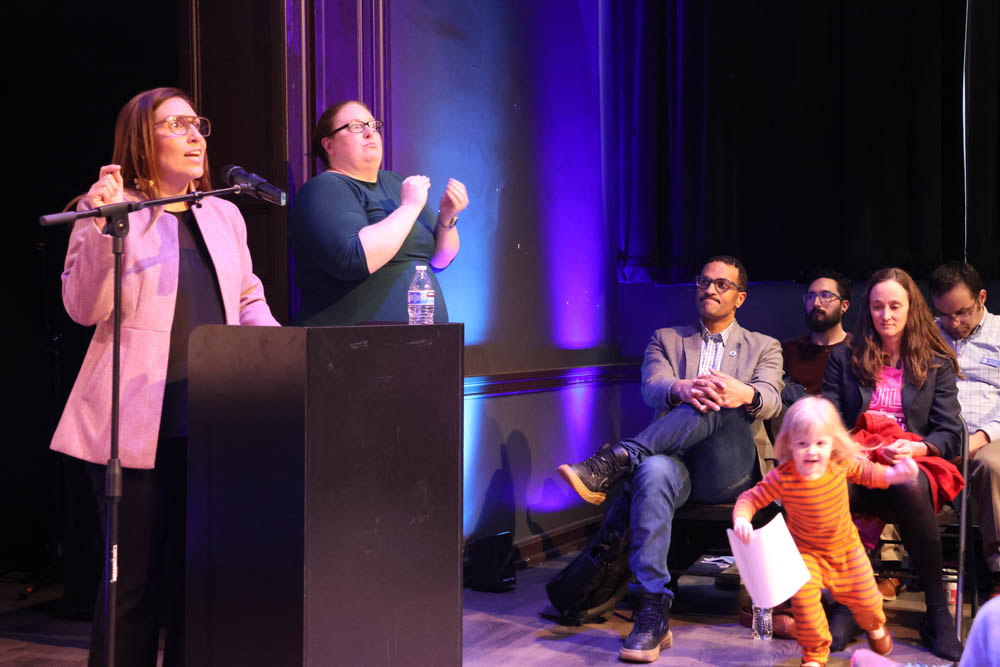
No major new information was presented, but some takeaways of note did emerge. Mosqueda declared that “this is a critical moment” for the West Seattle light-rail plan, which doesn’t yet have a full-speed-ahead commitment from the ST Board, while ST staff keeps trying to close multi-billion-dollar budget gaps. We recorded the full meeting on video in four sections – here are the introductions, which also included welcomes from Rachel Porter of the West Seattle Chamber of Commerce and Shannon Woodard of DNDA (which owns the venue):
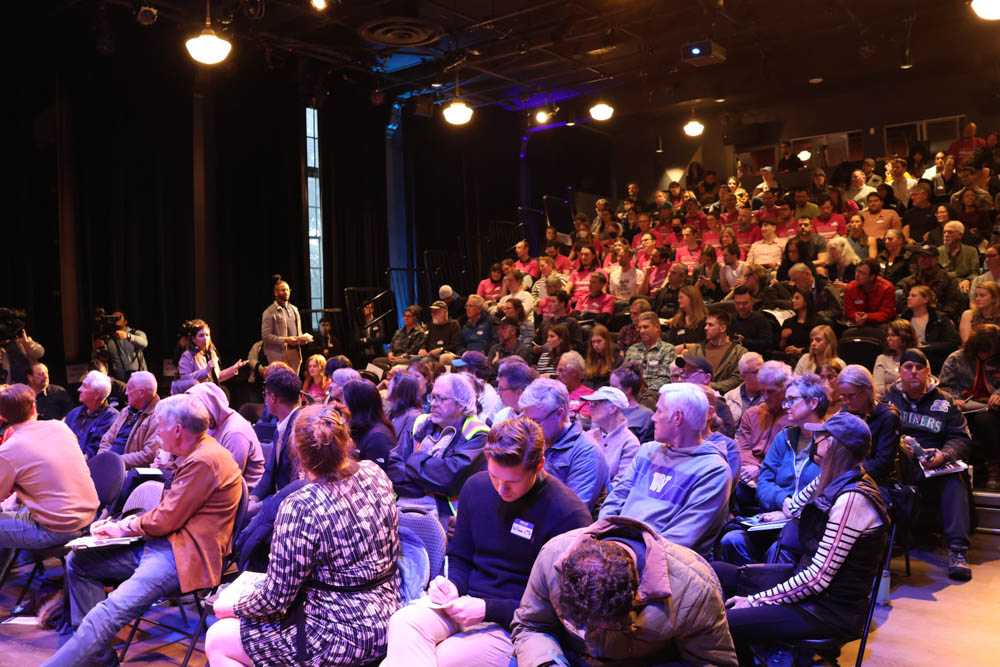
Youngstown Cultural Arts Center brimmed with people – including an overflow area (where Zumba would usually be happening this time). West Seattle Urbanism members were out in force, sitting together in the audience in special T-shirts, holding signs, and spiritedly applauding many of the points made.
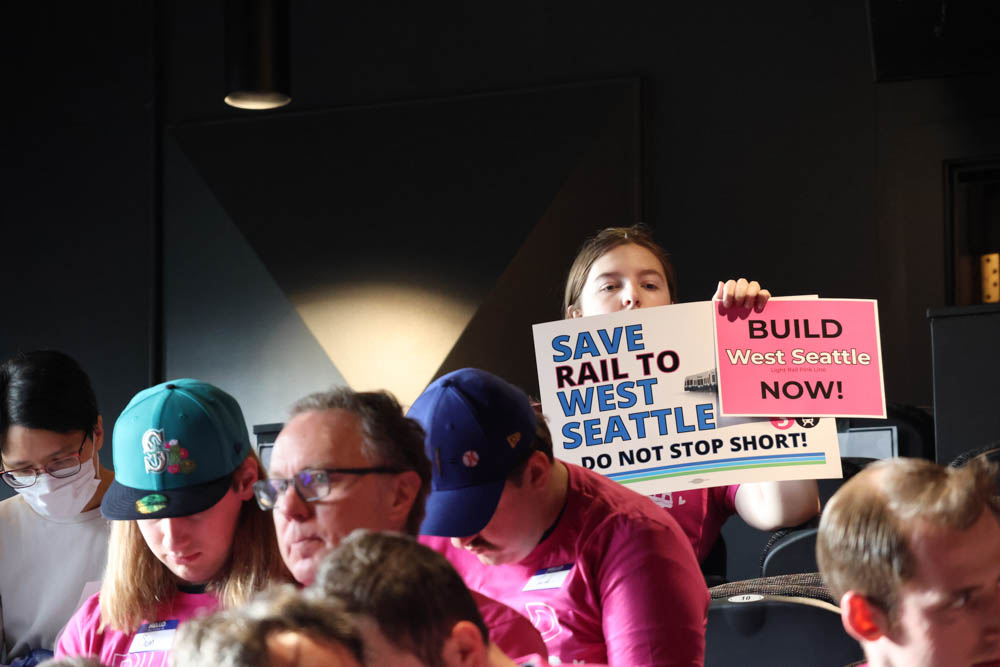
Along with Councilmember Mosqueda, other elected officials on hand included Mayor Katie Wilson – who spoke – and City Councilmember Rob Saka – who did not, as well as State Representative Brianna Thomas and School Board president Gina Topp. Mosqueda did much of the talking and had enough ebullience for a trainload of supporters, stressing that the West Seattle project is “shovel ready” (that was explained later) and recapping some points of ST’s latest proposal, as well as two things she hopes to get the agency to do – give displaced businesses the right of first refusal for the new spaces in stations on their old sites, and partly offset their rent before they have to vacate, so they can stay as long as possible. Meantime, she handed the mic to Mayor Wilson, who’s also a new ST Board member, and spoke enthusiastically of ST’s big event last Saturday, opening the cross-Lake Washington line, and elaborated on the “shovel-ready” term, saying she expects “shovels in the ground this year.”
Mayor Wilson said West Seattle light rail is a “historic opportunity we need to seize.” She expressed confidence that the ST Board would come up with a plan to deliver light rail, and vowed that as a “lifelong transit rider and longtime transit organizer,” she would ensure it happens. She wasn’t around for questions later because she left after speaking, saying her “little orange tornado” – aka daughter, who had accompanied her – had to get to bed.
Councilmember Mosqueda then introduced the Sound Transit team – CEO Dow Constantine (who noted he started the job almost exactly a year ago) and executives Brad Owen and Jason Hampton.
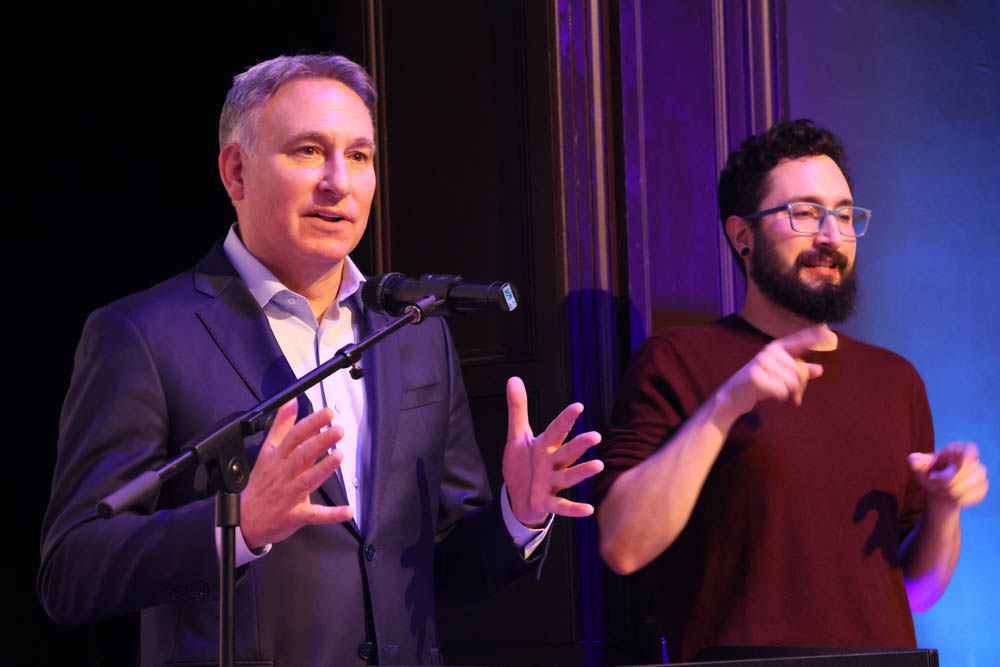
Constantine, like Wilson, noted the cross-lake service launch and said the fulfillment of a decades-long dream was proof “we have the expertise, creativity, resolve,” to get ST3 done. And he specifically promised: “We will get to Tacoma, we will get to Everett, we will get to Issaquah and other points on the Eastside, believe me, we will get to Ballard, and we are going to get to West Seattle. It won’t be easy – nothing worth doing ever is.” The latter declarations were tonight’s only allusions to potential “approaches” shown to the board during its recent retreat, potentially cutting out Ballard and in one case deferring West Seattle. The “approaches” weren’t mentioned in the presentation by Owen and Hampton at all:
What they did focus on, as the video shows, is the proposal we reported three weeks ago, when it was first presented to an ST Board committee – dropping the Avalon station, shifting part of the Delridge alignment north and relocating the tunnel portal, and shrinking the Junction station.
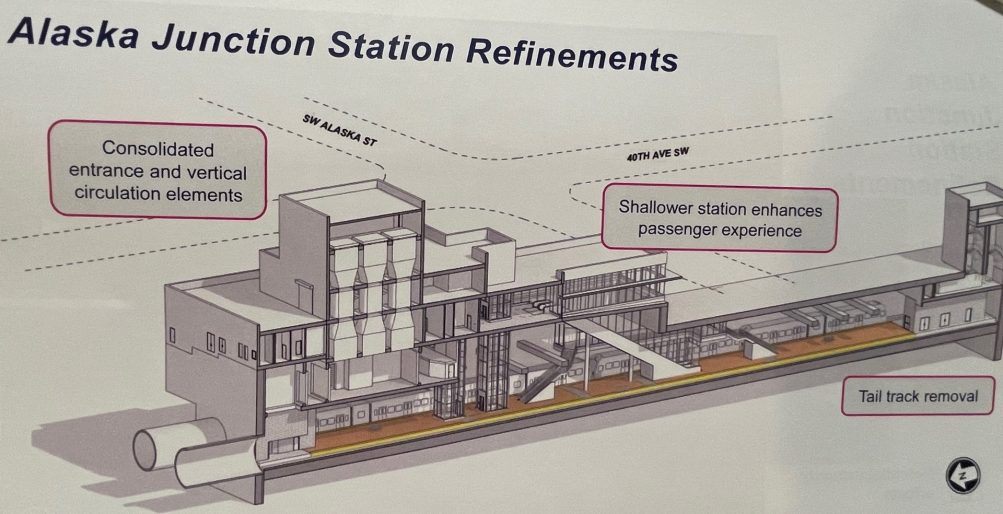
This is all part of a plan that could cut the cost by up to two and a half billion dollars.
Some of the notable points:
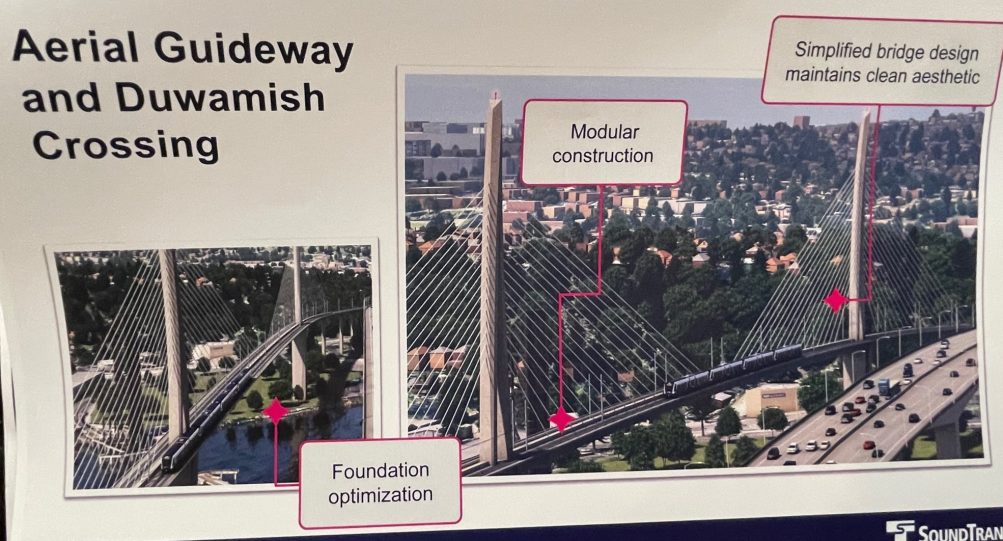
-The presentation (here’s the full slide deck) included a look at the rendering of the new cross-Duwamish bridge that would be built for light rail – which they also noted would not put any supports in the water.
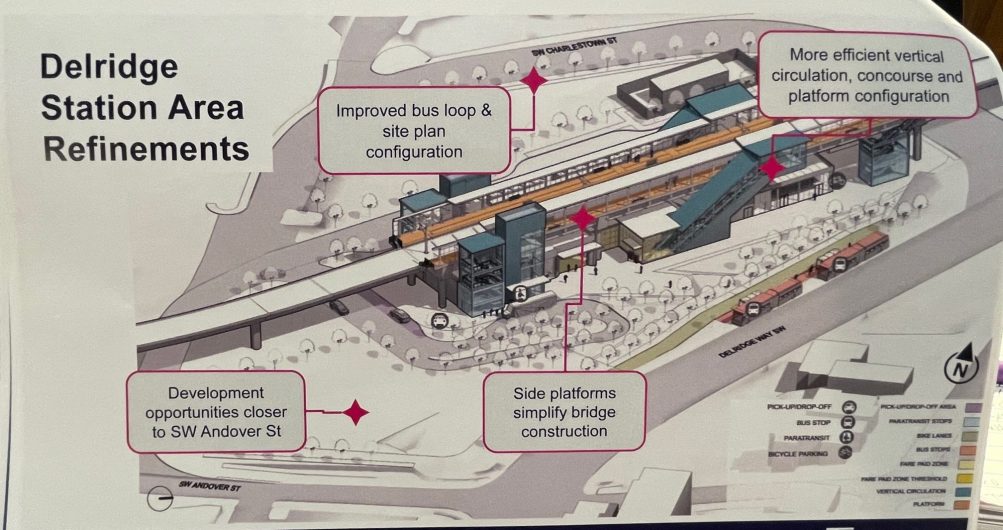
-Not only would the Junction station be shallower (35 feet instead of up to 70), the Delridge station would be “brought up” so escalators and stairs would be shorter
-They’d said previously that dropping the Avalon station would have little impact on ridership; tonight, we learned how little – 200 riders
-The “crossover” area that would be dropped from the Junction plan would have been up to 130 feet deep
-The new plan “does not preclude extending (light rail) to the south
“We believe there’s a lot of opportunity,” they concluded.
Then, the hour of Q&A, with some comments thrown in:
First and most recognizably was Chris Mackay of the West Seattle Junction Association, saying that while it’s not perfect, this just needs to get done.
Takeaways (including some clarifications, and some reiterations of long-made points) from the rest of Q&A
*No, WS is not a dead end – it will connect to the “spine” and take people all the way to the Everett end eventually
*How does projected ridership compare to the rest of the system? The ST execs said they didn’t have comparison numbers but Delridge was projected around 5,800 daily and The Junction aroud 7,600, while SODO would be an increasingly important transfer spot.
*It was clarified that no grocery stores will be affected by the revamped Junction plan
*The fact that Jefferson Square will be spared – yes, even Nikko Teriyaki! – was reiterated
*This has been said time and again but it was said again tonight – Metro won’t change bus routing until Ballard light rail opens, so the downtown lines will remain in service at least until then (separate from the “approaches,” Ballard still is officially expected to be running in 2039).
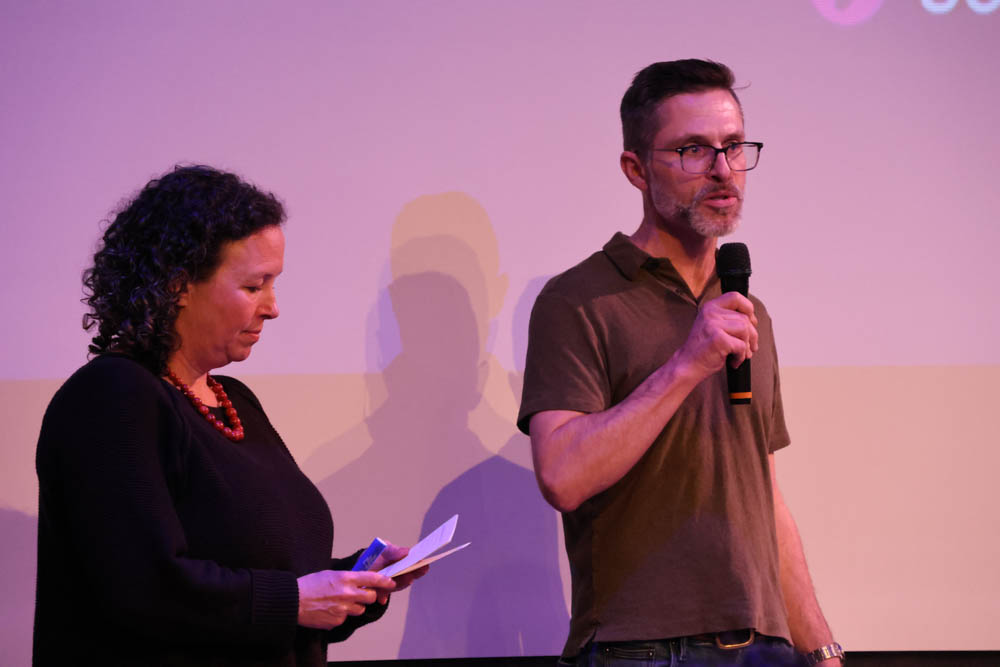
Two Metro reps indicated extensive planning continues for bus routes’ future
*Speaking of buses, someone asked, how many light rail riders would have been bus riders instead? The ST duo didn’t really have an answer for that.
*They’re expecting “lots of good union jobs” in constructing the West Seattle Link Extension, confirmed Katie Garrow of MLK Labor, who had spoken briefly earlier in the evening. And she and Councilmember Mosqueda promised those would be available widely.
*What does “shovel-ready” really mean? Owen replied that it means early work paving the way for construction – first acquiring needed property, then drlling test holes, and working with SDOT to see what could be done in the right of way. “It’s not like we hit the ground running and the whole area’s torn up on day one.” A bit later, he said they’re working on contracts now so that if and when the official green light is given, they’d be ready to “push them out” and start getting contractors on board.
*Couldn’t the second downtown tunnel be dropped to save billions? Owen said it would be “incredibly complicated” to try to operate the expanded system without a secod tunnel.
*Would both West Seattle stations open at the same time? Yes.
*Will special efforts be made to ensure people from Alki and Beach Drive can get to Link, since they’ve lost bus service over the years? The Metro team said there’s an effort under way to study long-suspended service, and that there would be community involvement.
One of the last questions – when will a decision be made? End of the second quarter, Owen said. Mosqueda, though, said she hoped sooner, like May.
Since County Councilmember and Sound Transit Board member Teresa Mosqueda announced three and a half weeks ago that she was organizing another West Seattle light-rail forum, much has happened: The highest-profile development was the board retreat, with staff presenting three ideas for “approaches” the board could take to craft an affordable plan (WSB coverage here). One “approach” even envisioned “deferring” West Seattle expansion, and all three would stop the planned Ballard expansion short of actually reaching Ballard. None of the approaches was an actual proposal, but they were meant as food for thought, at the very least. So with all that out there, the planned April 1 forum is one of the big events in the week ahead.
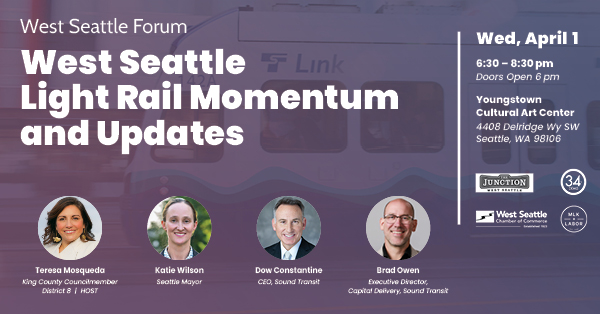
The Wednesday forum, starting at 6:30 pm at Youngstown Cultural Arts Center (4408 Delridge Way SW), promises “more detailed information and analyses on potential cost-savings and service delivery updates to West Seattle” in service to “continuing momentum on the West Seattle light rail expansion.” The announcement also promised time for “questions and answers, both on note cards and at roaming microphones.” This follows a forum Mosqueda presented last November (WSB coverage here).
By Tracy Record
West Seattle Blog editor
The newest proposal for Sound Transit light rail to West Seattle – dropping the Avalon station, which shifts the tunnel portal eastward – would dramatically cut the number of properties ST would have to acquire.
That was a headline from the “roundtable discussion” that took almost an hour and a half of this morning’s meeting of the Transportation, Waterfront, and Seattle Center Committee, chaired by District 1 City Councilmember Rob Saka.
ST’s West Seattle project executive Jason Hampton told the committee they’re now calculating that about 100 properties would be displaced by the Avalon-less alignment, which also would include a downsized, shallower Junction station. They don’t have the breakdown of exactly how many businesses and residences that would break down to, Hampton said, but it’s about a third of the 160 residences and 130 businesses the original plan would have displaced.
One thing that’s not changing, though, so far, is the Delridge station site, and two of the small-business proprietors facing almost certain displacement were among the guests for the discussion.
Ounces proprietor Laurel Trujillo said it’s great that ST is able to offer more compensation now but she still envisions a gap between what it really will cost to relocate, and what kind of compensation will be available. “Where does the money come from?”
Mode Music Studios (WSB sponsor) and Mode Music and Performing Arts (nonprofit) proprietor Erin Rubin noted that it’s been a long process and she too remains worried about personal impact – like having to take out loans. She said she was happy to hear that some changes in the ST process mean they’ll be able to directly pay vendors involved in relocation, rather than having the businesses themselves cover everything up front and wait for reimbursement later.
Much of what was described as available to business owners involved consulting rather than cash: Representatives from various city teams, as well as the Rainier Valley Community Development Fund, spoke about the ways in which they offer advice and information to help businesses get through the process. (More details are in the slide decks linked to the meeting agenda.)
Some suggestions came during a surprise appearance from County Councilmember and Sound Transit Board member Teresa Mosqueda, returning to the City Council chambers where she served on that body for years. She first recapped (as we reported here) her, and other North King County Sub-Area reps’, commitment to getting light rail to West Seattle and Ballard (plus finishing the Everett-to-Tacoma “spine”). Her suggestions for helping businesses included covering some of the rent that would enable them to stay in their current locations as long as possible, to minimize the number of boarded-up buildings pre-construction, and giving displaced businesses the “right of first (refusal)” to return to their old sites when the new station-area buildings are built there, even knowing that might be five years after a move.
There were no votes taken today; it was acknowledged that the uncertainty has somewhat intensified until the ST Board makes a decision – expected by mid-year – on what to go ahead with building, and how to pay for it.
SIDE NOTE: The issue of who’s involved in these discussions came up toward the start and end of the meeting. In public comment, Jordan Crawley of the Alki Beach Academy – another business that’ll be forced to move because of the Delridge station – accused committee chair Saka of excluding the West Seattle Chamber of Commerce, on whose board Crawley serves. Later, there was mention of a letter to that effect that councilmembers had received from the Chamber. We just requested and obtained that letter – see it here – in which the Chamber’s executive director Rachel Porter asks that the organization be included in any future discussions on helping businesses.
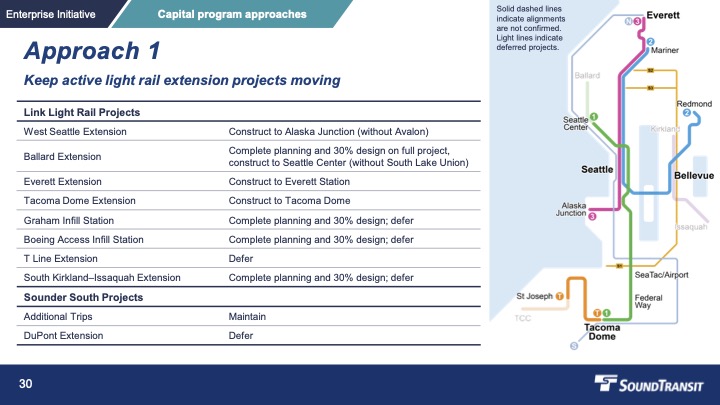
4:19 PM: Sound Transit Board members spent much of today in an all-day “retreat” meeting in Tacoma (open to the public in person but not streamed). But now that it’s over, the Seattle City Councilmember who’s on the board is sounding the alarm about new proposals for cost-cutting options. We’ve already told you about the increasing likelihood the West Seattle Link Extension plan would be trimmed to two stations – Delridge and The Junction (cutting Avalon). Councilmember Dan Strauss has issued a post-retreat news release sounding the alarm about three possible “approaches” staff presented to the board. His main point of alarm was that none of the three approaches would extend light rail to Ballard (which is in his district). Looking at the retreat slide deck to see what’s suggested for West Seattle in the possible approaches – you’ll see the first one would build to The Junction, as most recently discussed, as part of a plan to “keep (current projects) moving”:
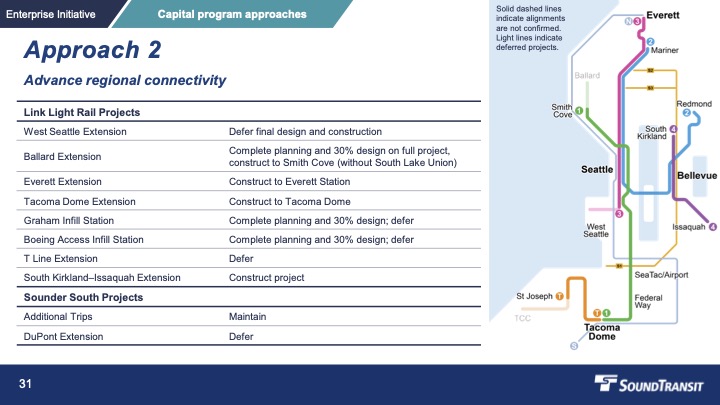
Second would “defer final design and construction” of the West Seattle extension entirely as part of a plan to focus on “regional connectivity”:
And the third would “phase” all light-rail projects, starting with building West Seattle light rail only to Delridge:
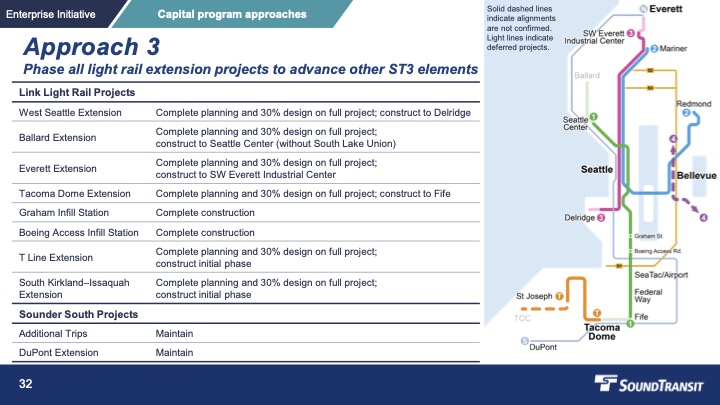
Here’s the full slide deck including these “approaches.” You’ll also see a page analyzing the potential approaches’ effects on ridership and travel time, among other things. No votes were taken today; it was just a discussion of possibilities. While Councilmember Strauss’s news release focused on Ballard, another councilmember who’s not on the board – Dionne Foster, the newest citywide rep – issued one with support for keeping West Seattle and Ballard in the plan, and board member King County Executive Girmay Zahilay also sent a statement, including “We must keep projects moving forward – as promised to voters a decade ago. The longer we delay, the more it will cost.” The board’s next meeting is March 26, a week from tomorrow.
5:45 PM: We sought comment from King County Councilmember Teresa Mosqueda, the only West Seattle resident on the ST Board. She has issued this statement:
I stand united with my North King County Sound Transit board colleagues in our commitment to delivering light rail to West Seattle and ultimately to Ballard, and we need the spine completed between Everett and Tacoma. To do so, we cannot work within the confines of limited information or stagnant revenue, nor can we accomplish further cost-savings measures if we don’t move forward with authorizing additional design work for some of our highest impact projects. The scenarios presented by Sound Transit today were not proposals to make cuts — they were intended to serve as the basis for conversation, and more analysis for the Board’s consideration is clearly needed. The cost savings work the Sound Transit team has done on the West Seattle plan shows what’s possible when we demand creative thinking and aggressively pursue cost-saving options: properties avoided, ridership retained, and billions saved. Now is the time to build on this momentum, move forward on shovel-ready West Seattle, and roll up our sleeves to explore all options to deliver light rail to Ballard and the spine so that this generational project delivers on its full potential.
Councilmember Mosqueda is organizing another West Seattle light-rail forum on April 1, as previously reported here; tomorrow (Thursday, March 19) District 1 City Councilmember Rob Saka‘s Transportation, Seattle Center, Waterfront Committee has a roundtable about light-rail business displacement, as previously reported here.
9:04 PM: We just talked to Councilmember Mosqueda by phone. She said the idea of choosing between the “three approaches” was basically considered a non-starter, and that staff was directed to come up with a “more sophisticated” plan for how the system could reach all the points voters approved – including West Seattle and Ballard. Since they managed to shave $2.6 billion off the West Seattle price tag in a few months of work, Mosqueda said, they should be able to find other efficiencies and savings around the system. She said it was a “missed opportunity” that they didn’t spend more time talking today about funding (here’s the document laying out the finance possibilities for one of the retreat’s “workstreams”). She repeatedly emphasized that West Seattle is “shovel-ready,” saying that if it gets the final go-ahead to proceed to final design and construction, “digging could start within 90 days.” She said she also refuted criticism that the West Seattle extension would only serve a “wealthy enclave,” noting that the peninsula is full of “working families” and that median housing prices here are a better gauge of reality than average prices.
So what’s the timeline now? Councilmember Mosqueda said that with the directive to staff to “sharpen their pencils” and bring back a plan with what it would take to reach West Seattle, Ballard, Issaquah, and other promised places, the board hopes to see that sort of information in May.
This Thursday morning during the twice-monthly meeting of the City Council committee chaired by District 1 Councilmember Rob Saka, two North Delridge business owners are scheduled to participate in a roundtable discussion about strategies for dealing with light-rail-related displacement. The roundtable discussion is on the agenda for the 9:30 am Thursday (March 19) meeting of the Transportation, Waterfront, and Seattle Center Committee; the local participants are Mode Music Studios (WSB sponsor) proprietor Erin Rubin and Ounces proprietor Laurel Trujillo. Both of their businesses will have to move under the current plan for the Delridge station, which at this point wouldn’t be changed by the newest cost-cutting proposals. Thursday’s roundtable participants also include reps from two city departments and the nonprofit Rainier Valley Community Development Fund, which has been working with local businesses. As always, the meeting will be streamed live, and recorded, by Seattle Channel.
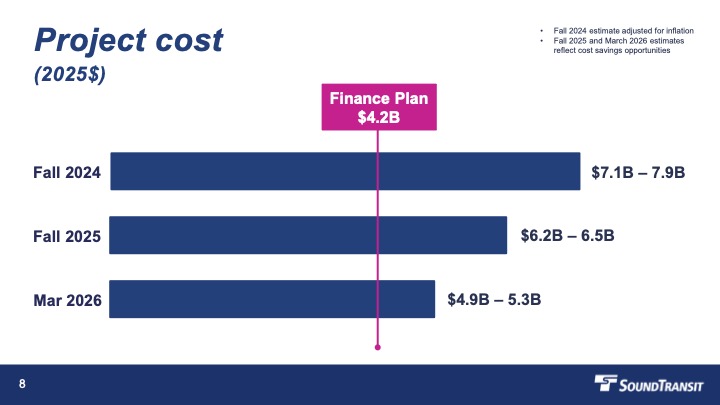
2:07 PM: In a presentation prepared for today’s Sound Transit Board System Extension Committee – meeting right now – ST staff says they can get the West Seattle Link Extension light-rail price tag down as low as $4.9 billion. The proposal would include three major components – first, dropping the Avalon station:
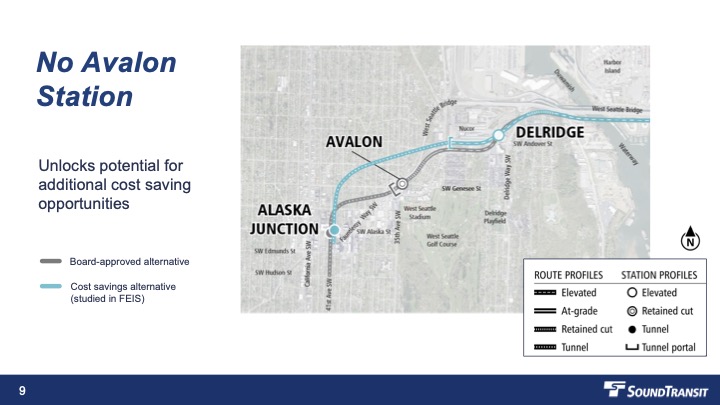
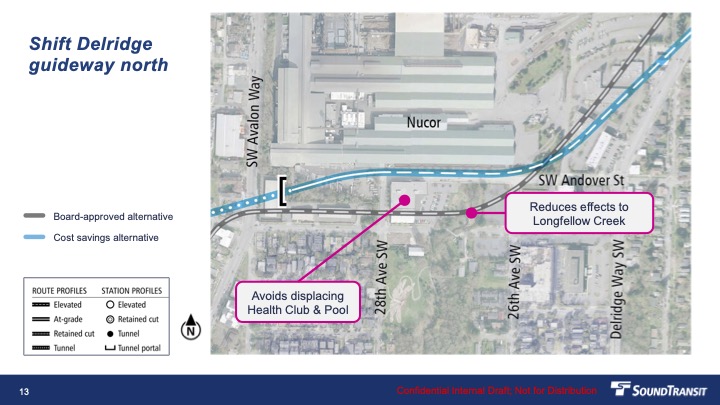
Then the Delridge guideway would shift northward, sparing West Seattle Health Club and reducing effects on Longfellow Creek:
And the Junction station would be smaller – sparing Jefferson Square:
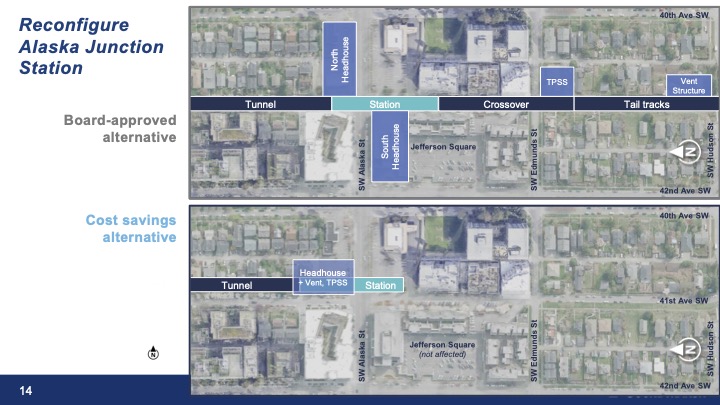
We’re monitoring the committee meeting remotely and will update as they discuss this (no votes are planned today, this is a briefing) – if you want to watch live, the link is in the agenda.
2:17 PM: The briefing, led by ST’s Brad Owen, is beginning, starting with a sheaf of background. Owen says “independent cost verification” has validated their projections. ST’s Jason Hampton, WS project director, then takes over. He says some of the smaller cost-cutting measures can just be incorporated into the design process, such as right-sizing Duwamish River guideway components. Those are the first level (“lever”) changes. In the second “lever,” they’d include various technical changes and also “removal of the tail track” so the “crossover” could be in front of the Junction station.
2:26 PM: Hampton gets to the Avalon station cut, which would be a “lever 3” – requiring board approval – decision. That means less impact on the southwest side of Avalon, for example, and a tunnel portal on the east side of Avalon. The reduced effects on Longfellow Creek would mean most significantly, “no over-water” passage of the track. The Junction station would be shallower – 30+ feet rather than 60+ feet down – because of changes including the tail-track elimination.
Owen notes that their current design contract still has a few months left, and then opens the floor for questions. Board member King County Executive Girmay Zahilay says he thinks it’s “just incredible” that ST staff could cut the cost from almost $8 billion to as low as just under $5 billion. Board member Cassie Franklin says she’s excited to see some of this work applied to other projects. Asked about grant opportunities, Owen says that given some federal changes, West Seattle has scored higher “so we’ve integrated that information into our grant assumptions.”
Seattle Mayor Katie Wilson, who recently joined the board, asks for details about “what we’re losing” by cutting the Avalon Station, and how community concerns can be addressed. Hampton said Avalon was expected to be low ridership and about half would have arrived by bus, so routes will be continued to serve them. He said community comment so far has been both concern about losing that station and support for making the project more affordable. Hampton said there’s some walkshed overlap between original station locations. Seattle City Councilmember Dan Strauss, also a board member, says he’s glad this would get light rail to The Junction. But he notes the gap between finance plan and cut-down cost, so “how much is contingency and how would we be able to” cut costs further? Contingency would be about 30 percent of this project’s total cost; the feds require “draw down” for contingency as a project proceeds. but not until they’re about to 50 percent of the process. Strauss presses, is that gap still all or mostly contingency? There are ways to work outside the process to “remove risk,” Owen replies. Strauss notes that the Husky Stadium project came in under budget and ahead of schedule, so this might be doable, he said. What about getting federal buy-in for dropping the station? Reply: They’ve already broached the subject with the feds and this is potentially within the scope of what was previously study, so it would be an “administrative” matter.
2:50 PM: Board member Kim Roscoe asked if any parking had been associated with the Avalon station; she was reminded that no Seattle ST projects have parking garages. Mayor Wilson then asked another question, about job creation (several labor reps had spoken during public comment). Owen said he didn’t have specific job numbers, and agreed with Wilson’s description of the project as “shovel-ready.” Birney asked if there’s a way to speed up the West Seattle project, “get it done sooner” so to save money that way. Right now there’s a “pretty optimized” schedule, so “the best thing we could do … is to move it into construction,” replied Owen. He said that once they start getting contractors on board, they might have ideas about how to speed it up.
County Councilmember Teresa Mosqueda – not a committee member but sitting in on the meeting – then had words of appreciation for the ST staff work. She suggests the newly proposed design modifications “go a long way toward what the community has been asking for,” including the reduced impacts, such as sparing Jefferson Square and WS Health Club. She said most of the comments she’s received are in favor of moving the project ahead. So, she asked, what’s next – including “daylighting this concept to the community”? Hampton said they’ve been “out in community” and promised an update to the project website, and said they’ll present this information “and a little more detail, even” at the April 1 forum that Mosqueda has announced. (Here’s the “what’s next” slide:)
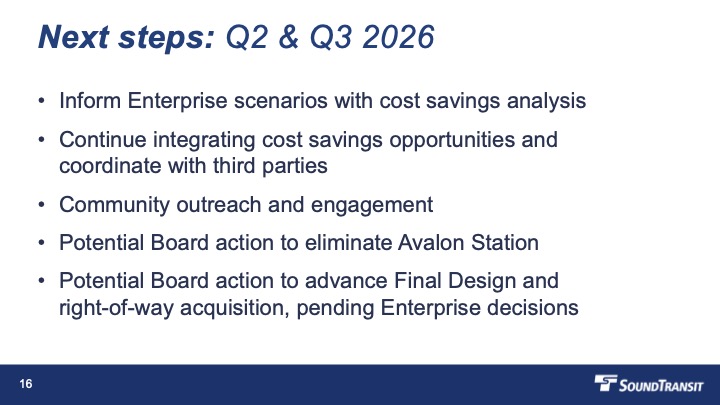
3:04 PM: CEO Dow Constantine then says this work will help them “wring” costs out of other projects too, and with that, the meeting is adjourned.
Though the Sound Transit Board is still weeks/months away from decisions about revising West Seattle light rail to get the projected cost closer to the available funding, a new city survey about station-area planning is out today. The survey only asks about Delridge and Junction station areas, a further reminder that the Avalon station is in the cost-cutting crosshairs. The survey is from the city Office of Planning and Community Development, which has planning processes under way for the Junction station area and Delridge station area, and that’s reflected in the survey, which only asks about those two, and includes this map – note that the areas of focus go far beyond the immediate vicinity of even just those two station locations:
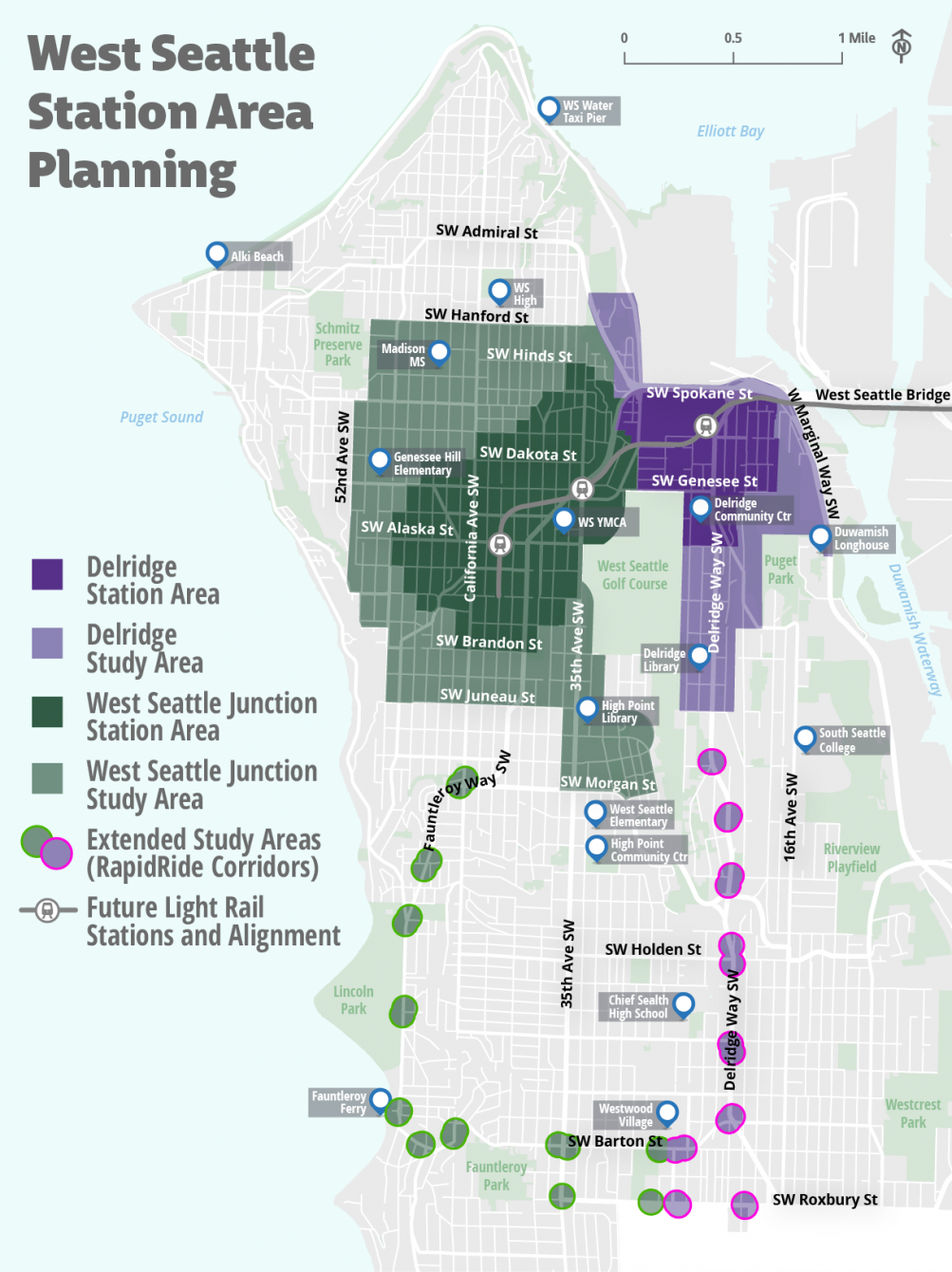
Here’s how the survey is explained:
The City of Seattle’s Office of Planning and Community Development (OPCD) and the Seattle Department of Transportation are kicking off a Station Area Planning effort in the West Seattle Junction and Delridge areas.
“Station area planning” is separate from Sound Transit’s light rail station design and construction. While Sound Transit determines where and how stations are built, the City of Seattle’s role is to work with communities to decide what happens in the neighborhoods that are ½ mile to 1 mile from the stations over the next 20 years. This includes decisions about housing, transportation, places for community to gather, safe streets, job access, and local businesses.
How to be involved
Take a brief community survey. Share your insights and experiences by March 27, 2026: bit.ly/StationAreaSurvey
The survey deadline is March 27. A major touchpoint ahead in Sound Transit planning, meantime, is the board retreat March 18, by which time the board is supposed to receive cost-cutting “scenarios” for projects including West Seattle light rail.
Just out of the inbox … the announcement of another West Seattle light-rail forum, on April 1st. The invitation comes from County Councilmember Teresa Mosqueda, currently the only West Seattleite on the Sound Transit Board.
I’m pleased to invite you to join me on April 1st at Youngstown Cultural Arts Center for a spring West Seattle Light Rail Forum. This West Seattle Forum will be an opportunity to get more detailed information and analyses on potential cost-savings and service delivery updates to West Seattle. This event is intended to follow-up on last year’s November forum where I committed to gathering this spring to get greater details on cost-reductions and design efficiency. This April 1st forum will discuss options for cost-savings and continuing momentum on the West Seattle light rail expansion. I hope you can join us for this important discussion on April 1st!
West Seattle Light Rail Forum: Momentum and Updates
Date: Wednesday, April 1st
Time: 6:30 – 8:30 PM (Doors open at 6:00 PM)
Location: Youngstown Cultural Arts Center
4408 Delridge Way SWPlease join me and Sound Transit Boardmember Mayor Katie Wilson, Sound Transit CEO Dow Constantine, Capital Delivery ED Brad Owen, and guest district City Councilmember Rob Saka. Thanks to our community partners elevating this forum, including the West Seattle Chamber, West Seattle Junction Association, MLK Labor and the 34th Legislative District.
Thanks also for your patience as Sound Transit worked to develop responses to the questions submitted at last year’s November West Seattle Forum. Sound Transit team has organized and consolidated related questions thematically and worked to provide direct, complete, and concise answers in an accessible format. The goal in the attachment is to create a digestible document that reflects the full range of questions and feedback we heard from the community. At the upcoming April 1st forum we will have more time for questions and answers, both on note cards and at roaming microphones.
I will continue working with Sound Transit staff to help facilitate clearer, more consistent, and up-to-date information for the West Seattle community throughout this year as the Sound Transit Board is poised to make critical decisions about how to move forward with the promised ST3 light rail expansion across the region.
At least one key date will precede this – ST Board members are supposed to have cost-cutting “scenarios” before their retreat on March 18th, which will be two weeks before the forum. (Here’s our coverage of the November event.)
38 minutes into that video of today’s Seattle City Council briefing meeting – their weekly meeting to both get briefings and offer individual updates – you’ll see a guest appearance by Sound Transit reps offering updates on Seattle projects: West Seattle Link Extension (due in 2032), Ballard Link Expansion (due in 2039), and the South Graham Street Infill Station (due in 2031). Alex Krieg presented an overview of the Enterprise Initiative, noting its intent is to remedy a “misalignment” of projected costs and projected funding for the entirety of ST3 – currently a $34.5 billion projected “misalignment.” (Here’s the full slide deck.) Neither he nor ST’s Brad Owen broke any news – that will come in a little over three weeks, when the Sound Transit Board gets a look at “scenarios” meant to bring down the price tag, for review at their scheduled March 18 retreat. “Everything is on the table,” the ST reps said. Councilmembers had an opportunity for Q&A; District 1 Councilmember Rob Saka was one of three councilmembers announced as having excused absences today, so he wasn’t there to ask West Seattle questions, but Councilmember Dan Strauss – whose District 5 includes Ballard and who also sits on the ST Board – called attention to what he considers a “really awkward situation,” the city’s responsibility to cover more than half the cost of the second downtown tunnel that’s currently part of the Ballard plan, a tunnel that some have suggested is unnecessary. He and the rest of the ST Board have their regular monthly meeting at 1:30 pm Thursday; the agenda explains how to watch/comment, in person or online.
By Tracy Record
West Seattle Blog editor
This afternoon’s Sound Transit Board System Expansion Committee meeting had two items of note for those watching the West Seattle Link Extension plan, still on record as pointed toward a 2032 launch. The question is, what will the plan look like once the staff and board are finished trying to reshape it into “affordability”? The process aimed at answering that question, the Enterprise Initiative, was the subject of another briefing at this afternoon’s committee meeting.
Before that was discussed, the first item of interest was another real-estate acquisition – a residential property on Pigeon Point. Not because it’s needed soon for planning/construction, but because, according to agenda documents, its owners have “medical circumstances” requiring them to sell soon, but because of the looming light-rail project, the agency says, nobody else will buy it. The board already has approved a couple other such purchases, and the committee sent this one on to the full board for approval (along with another in the Ballard project area), though with reservations voiced by Dan Strauss, the Seattle City Councilmember who sits on the ST Board – he revived a topic brought up with previous acquisitions, concerns about ST just letting the properties sit empty for years; apparently a policy change is in the works that might allow a different use for such properties, but not quickly enough to alleviate the concerns Strauss voiced.
Then it was on to the Enterprise Initiative briefing. The next major milestone is the development of “scenarios” for the full board to discuss at its retreat in March, so they can finalize an “updated ST3 system plan” by midyear.
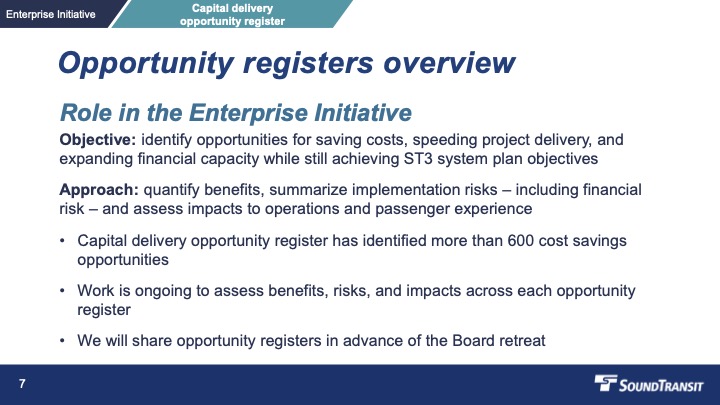
ST’s Brad Owen told the committee that they’re now evaluating more than 600 “opportunities” for getting the full ST system plan close to something realistic.
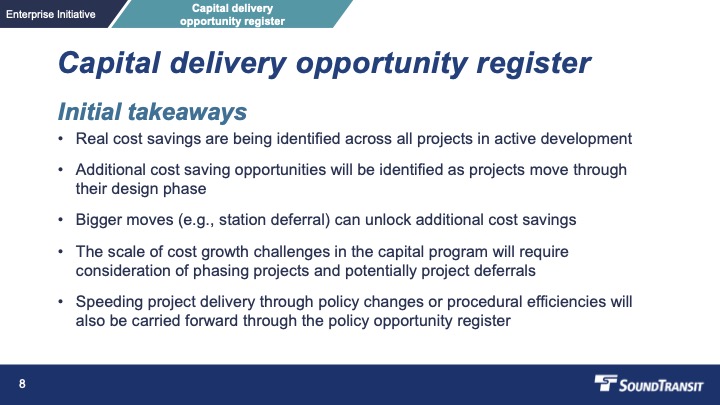
The “takeaways” from that work included another warning that project phasing or even deferrals might be required.
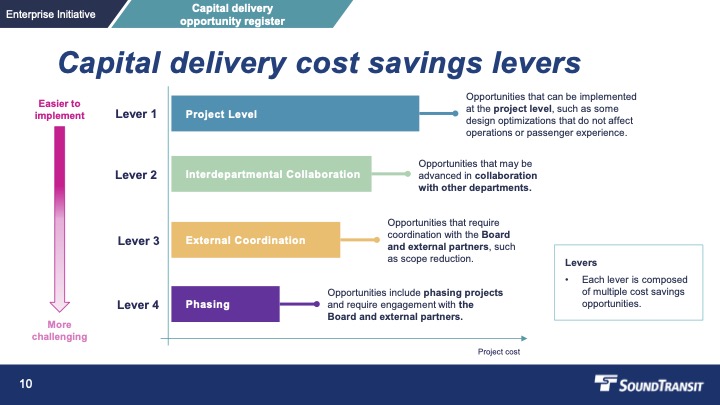
And as has been the case at previous briefings, they again discussed possible cuts/changes as “levers” of different levels that could be pulled. Then Owen presented examples of possible levers at each level, such as, in the West Seattle project, dropping the Avalon station.
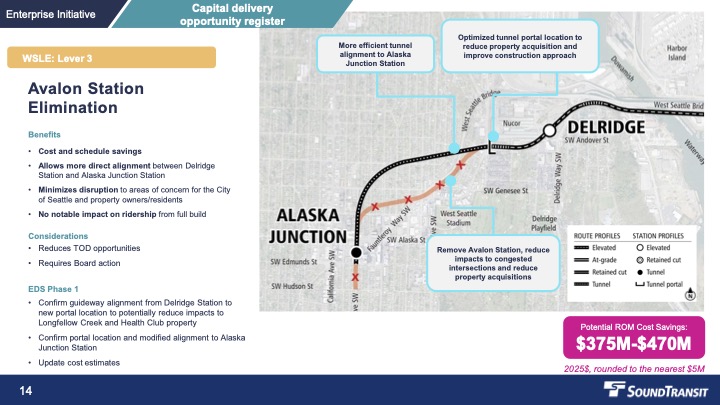
This, he said, would have “no notable effect on ridership” and would mean fewer property acquisitions, a more direct route from Delridge to The Junction, less impact on sites of concern like Longfellow Creek and the West Seattle Health Club property, with up to almost half a billion dollars in savings. (No new total project-cost estimate was mentioned at this meeting.)
Board approval would be needed for that or any other top level “lever” proposed – and keep in mind, what was presented today (here’s the full slide deck) was just a set of examples, not a formal proposal. And the West Seattle project isn’t the only one they’re reviewing for cuts – in addition to Ballard, there are Tacoma and Everett Link Extensions in planning, as well as Sounder and ST Express Bus projects discussed at today’s meeting. (Added: Here’s the meeting video.)
WHAT’S NEXT: The full board generally gets discussion items like this at its next meeting after committee briefings; that will be two weeks from today, on Thursday, February 26 – watch here for the agenda.
Another of our quick-look previews of the week ahead: The Sound Transit Board usually meets on fourth Thursdays, but this month, that’s Christmas Day, so it’s meeting on the third Thursday instead – December 18, 1:30 to 4 pm. The board members will include a new representative from West Seattle – King County Councilmember Teresa Mosqueda, a North Delridge resident, just appointed by new King County Executive Girmay Zahilay, who is also a board member. It will be the last meeting for outgoing Seattle Mayor Bruce Harrell; his successor, Katie Wilson, will be on the board starting next month. Here’s the agenda for Thursday’s meeting. It includes a report on the proposed downtown tunnel, which some have suggested could be dropped as a way to cut costs. Also, board members are expected to give a performance rating of “outstanding” to first-year CEO Dow Constantine while deferring a potential raise and bonus “at (his) request,” according to this document. The meeting at Union Station downtown (401 S. Jackson) includes a public-comment period; find out here how to watch/comment in person or online
| 20 COMMENTS