
West Seattle, Washington
01 Wednesday
After last year’s uproar over proposed encampment-removal rules that some interpreted as allowing camping in parks and on sidewalks, a new set of rules was promised. Today, the proposal has gone public, and a comment period is open. It’s in four documents, all here as PDFs. The main ones you’ll want to review are these two – first, the proposed removal rules:
Second, these are the proposed Multi-Departmental Administrative Rules:
Click the plus sign to expand the “for public comment: encampment rules” section of this page for commenting info.
It’s been three and a half months since the set of rules that the City Council was working on was basically shelved. The cover page for what’s now on the city website includes this summary:
Compared to the existing rules, the new rules:
*Identify specific criteria for prioritizing the removal of encampments.
*Require the offer of a shelter alternative in order to remove many encampments.
*Require the City to deliver materials it stores from encampments to their owners.
*Streamline the process for removing encampments that obstruct the intended use of public facilities like sidewalks and parks.
We’ll be taking a closer look later but are publishing the documents now so you can read for yourself if interested.
SIDE NOTE: While these rules apply to unauthorized camping, we’re taking this opportunity to remind you about tomorrow night’s West Seattle meeting related to the plan to authorize an existing camp on Myers Way. The meeting is at 7 pm Wednesday (February 1st) at the Joint Training Facility (9401 Myers Way S.)
The City Council usually starts Mondays with a morning briefing, and then gets down to business in the afternoon. Tomorrow morning’s briefing has three topics of interest – not to mention the likelihood they’ll be talking about some of what’s developed since the agenda came out. But just in case you’re interested, the agenda includes a Port of Seattle presentation (the slide deck includes a mention of the Terminal 5 project), an update on the city’s surplus-property disposition process, and the annual report on the Transportation Benefit District (fee/tax to raise money so the city can buy extra Metro service – you’ll see some C Line stats in the slide deck). You can watch live on Seattle Channel (online, or cable 21) starting at 9:30 am.
Trying to get a meeting with City Councilmember Lisa Herbold, like the person who started this WSB Forums thread? If you haven’t already heard via e-mail or via her blog-format website, next Friday brings Herbold’s next “district office hours” event. She’ll be at the Southwest Neighborhood Center (same building as SW Pool), 2801 SW Thistle, on Friday (January 27th), 2-7 pm. “Drop-in friendly” as usual, she says, but if you want to make an appointment, she says you can do that by e-mailing alex.clardy@seattle.gov.

(WSB photo from March 2016, outside Seattle City Hall downtown)
West Seattle/South Park City Councilmember Lisa Herbold says the mayor made “the right call” in announcing late today that the city will scrap its bicycle-sharing program for now, rather than replacing the failed Pronto system with something different.
Last March, she was one of two council votes against the bike-share buyout. So last month, we asked her about the bike-share situation during our wide-ranging interview looking back at her first year in office and ahead at her second year; she replied that she didn’t hold much hope the program would be scrapped, and restated concerns that a new version still wouldn’t serve our area.
Tonight, she published this statement after the mayor’s announcement:
This was absolutely the right call. With limited public dollars, these resources are better used to develop safe routes to schools for our students. Now is not the time for public investment in a bike share system.
I’m glad to see these funds are proposed toward implementing the City’s Bicycle and Pedestrian Master Plans, and School Safety projects, in line with my proposal last year to re-direct $4 million in funding away from expansion of the Pronto system toward these existing needs. I regularly hear from constituents about school crossing safety, most recently regarding Genesee Hill Elementary.
During last year’s budget cycle, I sponsored a budget action the Council adopted to remove $900,000 in funding for operation of the Pronto system in 2017 and 2018, to preserve funding for these existing needs.
Here’s how the mayor announced the bike-share change, redirecting $3 million to other pedestrian/bicycle programs.

(Photo by @34dems via Twitter)
Our area’s biggest political organization elected new leadership tonight, at its every-two-years reorganization meeting. The 34th District Democrats‘ new chair is David Ginsberg, shown above with Marcee Stone-Vekich, who declined to run for re-election after two 2-year terms. Per prescribed party process, the meeting was convened by the King County Democrats, and then Ginsberg took over after his election.
Two positions were contested: The first to be voted on was state committeeman – incumbent Chris Porter, challenged by Patrick Wicklund; Porter won 43-24.
(Voting in most races involved Precinct Committee Officers – the rules empower them to vote for all positions, while members who aren’t PCOs can only vote for secretary and treasurer.)
Also contested, county committeeman: Les Treall won over David Toledo, 55-12.
The rest of the slate of newly elected officers (asterisk denotes incumbent):
First Vice Chair – Treina Aronson
Second Vice Chair – Michael Taylor-Judd
State Committeewoman – Lisa Plymate*
County Committeewoman – Carrie Alexander
Alternate County Committeewoman – Martha Koester
Alternate County Committeeman – Ted Barker
Secretary – Jason Cheung
Treasurer – Gina Topp
The 34th Dems’ website has bios on those who had declared their candidacy pre-meeting – you can see them here. The group’s next meeting will be 7 pm February 8th at The Hall at Fauntleroy.
ADDED 9:29 PM: One more note from the meeting:
The 34th Democrats approve a resolution opposing Medicare privatization pic.twitter.com/yTFjcJRz7n
— 34th Democrats (@34dems) January 12, 2017
THANKS … to King County Council Chair Joe McDermott and the official @34Dems Twitter feed for info from tonight’s meeting.

(WSB photo, April 2016: Councilmember Herbold during brief break between appointments at a ‘district office hours’ session)
By Tracy Record
West Seattle Blog editor
This week marked the start of Lisa Herbold‘s second year as the first City Councilmember for District 1, West Seattle and South Park – one year since her swearing-in ceremony on January 4, 2016.
As we had done just before she took office, we invited her to sit down with us for an interview.
At the time we talked in December 2015, she had just been declared the winner of a race that had nine candidates on the primary ballot – with even more in the running before that lineup was finalized – and ended with her winning the seat by a 39-vote margin over Shannon Braddock.
Herbold won’t be up for re-election for three years. But we couldn’t resist asking, at the start of our conversation, if she is considering running for the biggest gig on this year’s city ballot.

We mentioned them a month ago – and now the “Democracy Vouchers” created by voter-approved Seattle Initiative 122 are arriving in the postal mail, if you’re a registered voter, or if you requested them. They’re a type of public campaign financing, property-tax-funded, that you’ll be able to use in three races that will be on this year’s city ballots – the two at-large City Council positions 8 and 9, and City Attorney. So far, two candidates have qualified for them, but others have until early June to qualify too. So how do you use them? The city website explains it all here. Answer to a particularly popular question: No, you can’t give yours to someone else.
West Seattle/South Park City Councilmember Lisa Herbold has “in-district office hours” today – 3:30-7 pm at the SP Community Center (8319 8th Ave. S.), “walk-in friendly” as described in her newest online update, just published/e-mailed. Also in that update is her report on this week’s council vote on capping move-in fees for renters. Since we hadn’t made note of the vote previously, we’re republishing what she wrote today:
On Monday, the Seattle City Council voted unanimously to pass the Renters’ move-in fee cap legislation. This legislation will require property owners who rent to work with tenants needing an installment plan to help renters better afford the high upfront costs required to rent. Earlier this year, the Federal Reserve announced that 46% of adults could not cover an emergency expense costing $400 without selling something or borrowing money. Seattle’s high housing costs make it increasingly difficult to live in Seattle. Even middle-income households, especially families with children, struggle to meet the high prices of housing in most areas of the city.
I also understand property owners need to collect move-in fees to mitigate the risks arising from tenant damage to units and moving out without proper advanced notice. Some suggested an exemption from this legislation for property-owners who rent 4 or fewer units. In lieu of exempting small landlords, the Council did the following: (1) Exempted move-in fees that total 25% or less than one month’s full rent; (2) Exempted owner-occupied units; (3) Adopted language that allows the tenant and property owner to negotiate a different payment plan then the one required by legislation; and (4) Requires that reservation fees, also known as holding fees, be subtracted from the total move-in costs, thus reducing the total subject to an installment plan.
This legislation will be evaluated over the next 18 months and I have asked that the evaluation of this legislation include an analysis of how small and large landlords are impacted by the legislation.
The Seattle Department of Construction and Inspections is charged with implementing the move-in fee legislation. If you have any questions, please contact Geoff Tallent by email at Geoff.Tallent@seattle.gov or by phone at 206-684-8452.
Councilmember Herbold’s full online update tackles a few other topics, too – read it in its entirety here.

Posters under the West Seattle Bridge aren’t unusual. This one is. Found out about it from a WSB reader’s text this morning – a poster along the Avalon/Admiral onramp, touting the white-nationalist group Identity Evropa with the exhortation, “Protect Your Heritage.” Though the poster appears new, the group has had a poster campaign under way in cities since mid-summer, according to online reports including this one and this one (the latter site also has a post specifically mentioning Seattle-area sightings in October, and the group’s own Twitter account showed a Seattle poster last month). The group rallied in San Francisco in October to protest its sanctuary-city policies, similar to those that Seattle’s mayor reinforced recently.
One year ago, Seattle voters approved Initiative 122, 63 percent yes, 37 percent no. A major component: A tax levy to pay for “democracy vouchers,” a step toward campaign-finance reform. Starting tomorrow, you can apply for your share of the vouchers, to be spent on qualifying city campaigns next year. If you’re already registered to vote, you will get them automatically – if you’re not a registered voter, today’s city announcement explains, you’ll have to apply:
Democracy Vouchers are a new way for Seattle residents to become more active in city government by donating to candidate campaigns and/or running for elected positions themselves. Beginning December 1, Seattle residents may apply to receive four $25 Democracy Vouchers to give to candidates running in the 2017 City of Seattle elections.
Registered voters in Seattle will automatically receive $100 in Democracy Vouchers by mail after January 3, 2017. Seattle residents do not have to be registered voters to receive Democracy Vouchers.
To be eligible to use the $100 in Democracy Vouchers, residents must:
Live in Seattle;
Be at least 18 years of age; and
Be either a U.S. citizen, U.S. national, or lawful permanent resident “green card holder”.If residents meet the eligibility requirements, they are encouraged to apply for Democracy Vouchers. The application is available in 15 languages [Amharic, Cambodian, Traditional Chinese, Simplified Chinese, Tagalog, Korean, Lao, Oromo, Russian, Somali, Spanish, Thai, Tigrigna, Vietnamese, English] at www.seattle.gov/democracyvoucher.
Seattle residents may only give Democracy Vouchers to participating candidates running for City Council or City Attorney. The program will expand to include the Mayor’s race in 2021. Residents may give participating candidates one ($25), two ($50), three ($75), or all four ($100) of their Democracy Vouchers.
Next year, two City Council seats will be on the ballot citywide, the “at-large” positions, currently held by Councilmembers Tim Burgess (P. 8) and Lorena González (P. 9). The other seven, elected by district, will not be on the ballot until 2019.
P.S. The city says it’s sending an “informational mailer” about this to every household in Seattle in about a week. Meantime, if you want to read the full initiative that created this – it’s here.
Earlier this week, we noted the West Seattle/South Park-specific items that City Councilmember Lisa Herbold still had in play as the council approached its close-to-final budget votes.
The council’s votes on more than 150 changes to the mayor’s budget played out over a long day, with some items debated separately, most considered in groups. We lost track along the way. But in her newest online update, Councilmember Herbold provides this recap, in this order, of what made it through. (For the items that were voted on this week, we’ve linked the titles below to the download links from the budget meeting.)
Fauntleroy Boulevard Project – City Light has revised the description of the project to allocate $1.5 million for the street light improvements and utility pole relocations recommended by community members as integral to the revised design.
West Seattle Bridge studies – This will continue work the work begun by former Councilmember Tom Rasmussen, by adding $100,000 to complete the two studies called for in a budget action last year to carry out the evaluations called for in the West Seattle Bridge/Duwamish Corridor Whitepaper to improve safety, incident management, and traffic flow.
Age-Friendly Community Innovation Fund – This funding will support a grant program for groups in each of the seven City Council districts to apply for up to $25,000 for programs and services based on improving the lives of an aging population.
South Park Family Service Center – This funding will support health and human services, a leadership program, and an education program in South Park.
T-5 Quiet Zone – Statement of Legislative Intent for SDOT that requests that they work with the Port of Seattle, the Federal Railway Administration, and the railway companies doing business at Terminal 5, to extend the quiet zone from Terminal 5 to the Delridge Way/W Marginal Way intersection.
A task force on South Park Public Safety – To formulate and report to Council recommendations regarding the public safety and vitality of that neighborhood. Including strategies that reflect the unique situations or dynamics of the neighborhood and are culturally and linguistically responsive data-driven approach to improving the City’s relations to and effectiveness with the South Park neighborhood. The report will go to Councilmember González’s Gender Equity, Safe Communities and New Americans Committee.
Herbold’s full online update includes her other budget proposals that made it through – including the $29 million housing proposal (here’s her statement after its passage) – and some that didn’t, including this one:
Community Planning Process for Myers Way Properties, Statement of Legislative Intent (SLI) – a community planning process to determine the future uses of the Myers Way Properties. In the budget process I learned that there are 5 other District 1 land-banked properties that have pending requests for planning resources. Moving this one forward would have resulted in the Myers Way property “jumping the line.”
At least three of the sites awaiting planning are in West Seattle – the landbanked park sites north of Morgan Junction Park, on SW Charlestown, and on 40th SW (where the temporary Fire Station 32 is now).
Meantime, the amended budget is due to be finalized next week.
The City Council is close to making final decisions on the city budget. Some of the changes proposed in recent weeks have been scrapped, and some new ones have been added. Tomorrow morning at 9:30 am, the council will go through the newest list of changes still on the table. See the current full list here; ones of potential interest in our area include:

(WSB file photo by Christopher Boffoli)
WEST SEATTLE BRIDGE CORRIDOR STUDIES: Our area’s Councilmember Lisa Herbold proposes spending $100,000 on two studies:
This proposal would provide one-time funding for two traffic management studies: (1) evaluate the feasibility of traffic management modifications to improve the eastbound Spokane St Viaduct connection to I-5; and (2) initiate an SDOT/WSDOT Peer Review Team to review traffic operational and safety improvement opportunities on upper and lower roadways and make recommendations.
These were originally proposed in last year’s West Seattle Bridge Corridor “whitepaper.”
SOUTH SEATTLE COLLEGE’S 13TH-YEAR PROMISE PROGRAM: This proposal from Councilmember Bruce Harrell would allot a quarter-million city dollars to support the SSC program that provides a year of free tuition to any interested graduating senior from designated high schools:
The 13th Year Promise Scholarship program provides all graduating seniors from Cleveland, Chief Sealth International, Rainier Beach, and soon West Seattle high schools with one year of free in-state tuition at South Seattle College. Additionally, the program offers students a variety of workshops during their senior year to prepare for college enrollment and to improve math and English skills if necessary.
The funding provided in this green sheet is intended to assist South Seattle College in expanding the reach of the 13th Year Promise Scholarship program by funding non-tuition components of the program, freeing up existing resources to be used for the tuition expenses. This funding may be used for the Readiness Academy, COMPASS Improvement Workshops, and the 13th Year Bridge Program
TERMINAL 5 QUIET ZONE: Also from Councilmember Herbold:
The Port of Seattle is considering improvements to Terminal 5 to modernize the facility. As part of this project, the Port is considering implementation of shore power, a Terminal 5 quiet zone, and broadband back-up alarms to reduce the noise emitted from Terminal 5.
This Statement of Legislative Intent (SLI) requests that SDOT work with the Port of Seattle, the Federal Railway Administration, and the railway companies doing business at Terminal 5, to extend the quiet zone from Terminal 5 to the Delridge Way/W Marginal Way intersection.
The SLI requests that SDOT provide quarterly reports on this work to the Planning, Land Use, and Zoning Committee.
SOUTH PARK PUBLIC-SAFETY TASK FORCE: Proposed by at-large (and WS-residing) Councilmember Lorena González:
The Council requests that the Executive convene a Special Task Force of South Park residents to formulate and report to Council recommendations regarding the public safety and vitality of that neighborhood. It is the Council’s understanding that the written report of the Special Task Force would, as a general matter, accomplish the following:
1. Identify strategies for a new model of neighborhood policing, which will build on the micropolicing plans and community policing plans initiated by Chief Katherine O’Toole. The strategies should be replicable in other neighborhoods throughout the City, while flexible enough to reflect the unique situations or dynamics of other diverse neighborhoods; and
2. Identify strategies for a culturally and linguistically responsive data-driven approach to improving the City’s relations to and effectiveness with the South Park neighborhood, which will also inform the City’s engagement with all other neighborhoods.
COMMUNITY INVOLVEMENT COMMISSION: The final step toward creating the mayor’s proposed Community Involvement Commission – to be a liaison group instead of maintaining ties to neighborhood district councils in that role – is spelled out in this item (PDF), which also redefines the Department of Neighborhoods’ role. It strikes out the word “neighborhood” in many cases, although one amendment is proposed: ” Subsection G would add support for neighborhood-based community-building to the list of functions of the Director of the Department of Neighborhoods.” Each City Council district will have one representative on the group; 7 other members would be appointed by the mayor.
The list of proposed changes will itself change before tomorrow’s meeting – while we were writing this story, it grew to 143 items – but you can review the titles and brief descriptions and look at others that might interest you by going here. If you have strong feelings, pro or con, about any of them, contact councilmembers ASAP – the info is all here (our area’s rep is at lisa.herbold@seattle.gov, and she’s been providing budget-process explainers on her website).
Received tonight from the Chief Sealth International High School Black Student Union:
The Chief Sealth International High School Black Student Union will be participating in a schoolwide walkout and rally outside of Chief Sealth Intl. High School on Monday, November 14, 2016 @ 1:30 PM. In this rally, we want to show that our students are here for each other and that we won’t back down. We are proud of our school’s diversity, no matter who’s elected into office or what they may say.
After the election of Donald Trump as president of the United States, there has been a heightened fear among Students of Color, Immigrant Students, Muslim Students, Female Students, and more. The examples of hate crimes and discrimination all over the country has our students afraid for their future and the future of their friends and family.
We say “heightened” because the struggle for Students of Color, Immigrant Students, Muslim Students, and Female Students is not new. It has been ongoing, and we come together today to show that we will have each other’s backs as we enter this new era.
We will not be afraid. We know that when we stand together, we are strong. We know that when we stand together, the racism, islamophobia, anti-immigrant sentiment, homophobia, and misogyny that Donald Trump stoked during his campaign will not find a voice in our community. We know that when we all stand together those that have been empowered by this election to express racism, islamophobia, homophobia, anti-immigrant sentiment, and misogyny will recognize that those ideas have no home here.
In this walkout, students at Sealth and the Sealth Student Cultural Coalition, which includes members from the Black Student Union (BSU), Muslim Student Union, (MSU), Movimiento Estudiantil Chicano Latino de Aztlán (MECHLA), Asian Culture Association (ACA), and the Gay-Straight Alliance (GSA) will be coming together. We hope to show the rest of the world that we stand in solidarity with each other. We invite cultural organizations from other schools to do the same.
This walkout and rally will be NON-VIOLENT. We will not welcome violent actions.
Back on Wednesday, you might recall, about 200 students from West Seattle High School walked out for a post-election protest march from Admiral to The Junction and back to school.
Meantime, this isn’t the first action this year in which the Sealth BSU has been involved – we covered their pre-football-game protest in September, as well as their Black Lives Matter At School rally three weeks ago. Last December, the group organized an anti-Islamophobia demonstration.
By Tracy Record
West Seattle Blog editor
The night after the Democratic Party lost the White House, you might have guessed a local party meeting would be funereal.
Sadness, however, was only one of the sentiments and emotions displayed at last night’s 34th District Democrats meeting. Also: Resolve, fury, pragmatism, and optimism, among others.
It started early. The Pledge of Allegiance always opens 34th DDs meetings, and this time, at the end, someone added: “HOPEFULLY, justice for all.”
Shortly thereafter, chair Marcee Stone-Vekich, after saying, “I can’t give you any kind of speech right now… I’ve got nothing to say,” managed to offer her thoughts: “I never in a million years thought it was possible for this particular person to become the president-elect. So what I do know is that we need to gather, we need to organize, and if we need to, we need to take to the streets like the hundreds who did so in our city tonight, New York, Chicago, all over the country, and that may be what it takes. This has an impact on people’s daily lives. My daughter .. is a Type 1 diabetic. She is 28 years old. If Obamacare goes out the window, what do you do? … I am comforted that you are here and hopeful that we can move forward.” Read More
The photo and report were sent by Brenda:

She explains, “We stumbled upon an awesome refuge tonight at Endolyne Joe’s, celebrating their Canada menu. It was nice to get away for a couple hours and enjoy some poutine!” The Toronto menu itself is not an election reaction – it was launched almost a month ago; Endolyne Joe’s (a WSB sponsor) has special regional menus that change every few months.

10:23 AM: About 200 students from West Seattle High School have walked out of their classes and are headed south on California SW toward The Junction.
(Added: Reader video from Molly – profane language alert)
It’s been described to us as a reaction to last night’s election results.

10:50 AM: The group has reached The Junction. A TV helicopter has picked up on this so if you are hearing/seeing a helicopter, that is what is going on.
11:15 AM: Sorry about the site slowness – this has caused a huge traffic surge.

The group rallied at the Jefferson Square corner plaza (photos above and below) and then headed back to WSHS, where we’re told they’ll be talking with principal Ruth Medsker.

What participants were telling us is, what happened last night does not represent the future that they want, the America that they believe they belong to and belong in, and they will work to embody the values they want to see represented.
Organizer Max Lemke (photo below) told his classmates that they need to be better people, so that there is hope for their future. Love will trump hate, he told them.

(added) One woman passing by, describing herself as a “proud grandma,” high-fived some of the students:

11:48 AM: At the school, the principal took the students into the theater so they would have a place to talk. She said she understood they were angry and wanted to express it. Media were not allowed in.
ADDED 5:11 PM: Seattle Public Schools spokesperson Luke Duecy says, “During today’s student protest march at WSHS, students who walked out of school were marked absent and will need to make up any work missed. No students will be disciplined. Instead, staff talked with students about their desire to express themselves and they supported students’ emotional needs. No teachers walked with students. Two vice principals did for safety and security reasons. Some parents also joined.”
While it is not directly related to the WSHS protest, we also are including a statement Seattle Public Schools has issued in the election’s aftermath:
Seattle Public Schools serves a rich and diverse school community. Our students speak 143 languages/dialects and come from 147 countries. Media coverage of the candidates’ positions on immigration, ethnicity, gender, and religion permeated our students’ lives over the last year. Even our youngest students were aware of the polarizing rhetoric. Today, we have heard directly from families who are feeling anxious and concerned.
The election outcome doesn’t change or influence the district’s direction, priorities, mission, or values. Seattle Public Schools continues to remain dedicated to providing positive school climates that promote student learning and development.
We are committed to building school communities where all students, families and staff are safe, respected and engaged. We will not tolerate bullying, intimidation or any other actions that sustain and advance prejudice and bigotry. Our commitment to the wellbeing of each and every student is stronger than ever.
From Mayor Ed Murray via e-mail:
Regardless of tonight’s national results, tomorrow Seattle will remain a city guided by the values of equality, inclusion and openness. Tomorrow we will continue to support women, we will welcome as neighbors our Muslim brothers and sisters, and tomorrow Black Lives will still matter. Our City will remain strong because of our diversity, not in spite of it.
In Seattle, our results show a city ready to lead in building a more equitable and progressive future.
As we look forward, we will challenge our people to live up to our values, to ensure we build on the foundation that was laid tonight and that we foster the equitable, inclusive world we envision.
Just in case you heard them and wondered – we have heard reports of apparent fireworks set off in multiple neighborhoods, from Arbor Heights to North Delridge, just as the presidential election was called for Donald Trump, who has just given his first speech as President-elect.
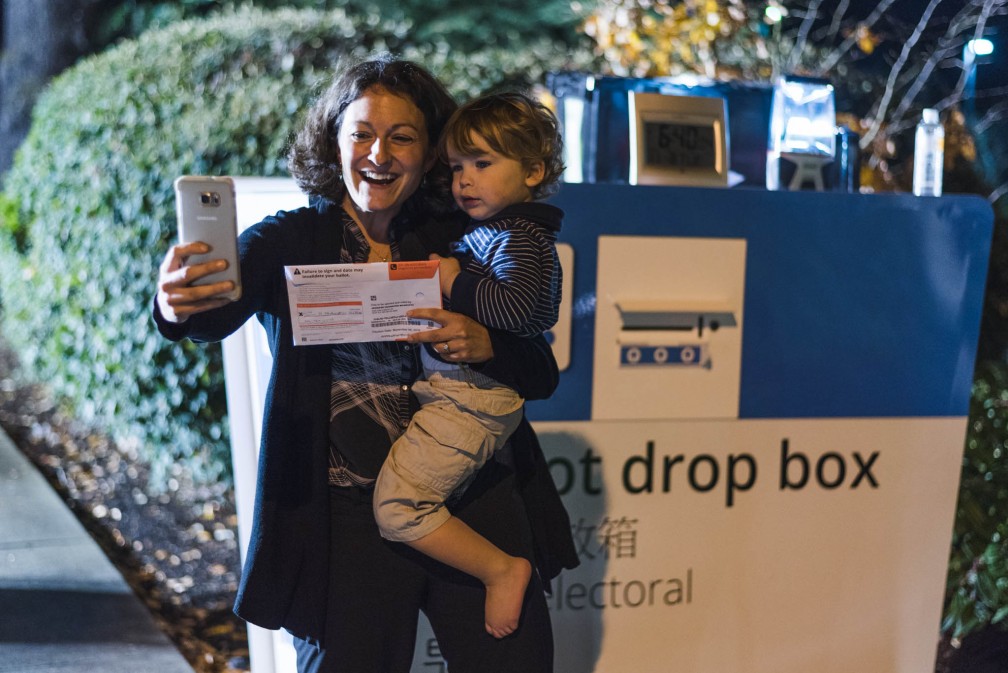
(Voter dropping off ballot at High Point box in final hour. WSB photo by Leda Costa)
8:35 PM: While the presidential race tops the night, ballots in our area had more than three dozen local/regional/state races of note. King County Elections has NOT YET released its one count for tonight, citing “a delay.” But some other counties are reporting, so here are links to the biggies – including statewide issues. We will add summaries once King County is in.
8:53 PM: King County results are out in a “plain text” format only – you can search through them here.
9:04 PM: King County results are fully reflected in the links below.
10:32 PM: King County says it’ll be updating results again at 1:30 am.
1:35 AM: The county site has indeed updated results again.
SOUND TRANSIT 3 (3 counties) – results here – 1:51 am, 55% yes
U.S. HOUSE DISTRICT 7 – results here – 1:51 am, Jayapal ahead with 57%
U.S. SENATOR – results here – 1:51 am, Murray ahead with 61%
GOVERNOR – results here – 1:51 am, Inslee ahead with 56%
LT. GOVERNOR – results here – 1:51 am, Habib leading with 56%
STATE SUPERINTENDENT OF PUBLIC INSTRUCTION – results here – 1:51 am, Reykdal ahead with 51%
SECRETARY OF STATE – results here – 1:51 am, Wyman ahead with 53%
COMMISSIONER OF PUBLIC LANDS – results here – 1:51 am, Franz ahead with 55%
STATE BALLOT MEASURES – results here – 1:51 am, 1433 passing with 60%, 1464 failing (53% no), 1491 passing with 71%, 1501 passing with 72%, I-732 failing (58% no), I-735 passing 64%. In Advisory Vote 14 and 15, “repealed” is ahead; proposed constitutional amendment, “approved” is ahead.
**All statewide-office results here**
34TH DISTRICT LEGISLATORS – results here
SEATTLE INITIATIVE 124 – 77% voting to approve
**All King County-only numbers are here**

6:38 PM: Our Election Night headquarters this year is Admiral Bird, which took reservations for its cozy space and is filling up.

Results have been on the big screen here for almost an hour and a half. “If anything is certain about tonight, it’s uncertainty,” said one of the CBS anchors just now. A moment later, CBS called Connecticut for Democrat Hillary Clinton, and a cheer erupted – first one of the night. We’ll have updates from here and from the West Seattle ballot dropbox, where WSB photojournalist Leda Costa is stationed as the 8 pm voting deadline approaches. (added) Jon sent this photo of daughter Sydney “helping me vote!”

6:50 PM: If you’re looking for somewhere to watch – we just checked a couple nearby spots; nobody at the West Seattle Library (2306 42nd SW), which has results on until 7:45, and not many at Parliament Tavern (4210 SW Admiral Way).
7:02 PM: “White-knuckles kind of night,” declares another CBS anchor, suggesting people are drinking. Yes, here at Admiral Bird, where wine and beer are offered as well as coffee, and it’s a pro-Clinton crowd, they are. Meantime, LOTS of voting. Leda sends this photo of an overflow bag, brought in after the dropbox has already had to be emptied twice today:

7:50 PM: A few minutes ago, the 15-minute warning was sounded at the dropbox:
As for the race, Trump has retained the electoral edge. The pro-Clinton crowd here has cheered when there was a reason to, such as the recent call of Colorado in her corner:
Colorado called for Clinton. Crowd here holding onto a bright spot. #ElectionNight pic.twitter.com/TzEWhU0iV7
— West Seattle Blog (@westseattleblog) November 9, 2016
Minutes left to get your ballot in. And we’ll get local results – which we’ll publish separately – within half an hour or so.
8:02 PM: More cheers as projections came in with the West Coast poll closings.
8:22 PM: King County’s results release has been delayed. Meantime, here’s the countdown from the West Seattle dropbox at the top of the hour:
Here at Admiral Bird, the big screen remains on CBS and the current estimated electoral-vote count is 197 Clinton, 193 Trump, with some major states as-yet-uncalled.
8:29 PM: Local TV has put up some early numbers in the statewide races but with conversation continuing to buzz, few realize that those numbers include no King County results yet. Meantime, CBS has called Florida for Trump, who is back in the electoral lead, 222-197. “This night has gone much differently than anyone has predicted,” says an anchor. Meanwhile, a TV photographer has showed up here.
8:40 PM: “I don’t understand how it’s this close,” says one of the 25-plus people here. Meantime, the one person in the room who seems oblivious to what’s unfolding on screen is many years away from voting:

On screen now, Trump 227 electoral votes, Clinton 197.
9:02 PM: The King County votes are finally tallied in a readable way – so we’re tracking the local and statewide races/measures here.
9:16 PM: The presidential race hasn’t yet been called; Trump 244, Clinton 209, is the current count. The CBS anchors also have shown a number suggesting the financial markets are not happy about it. “Holy s–t!” is the exclamation here, in reaction to that. Some have gone home.
9:30 PM: Two rounds of cheering, but not related to the presidential race – they cheered reports that Pramila Jayapal has won the 7th Congressional District seat, and that Sound Transit 3, set to bring light rail to West Seattle in 2030, is winning. Meantime, the electoral tally is 244 Trump, 215 Clinton.
10:02 PM: The electoral #’s haven’t changed (if you’ve lost track, 270 is required to win). A local TV cut-in brought a brief glimpse of Governor Inslee, who’s winning re-election tonight, and that sparked a cheer among the remaining partygoers here at Admiral Bird.
10:21 PM: Another couple comes up to the bar at the Bird, where we’ve been sitting. Going home, they say. “Going to sleep?” they’re asked. “Probably not” is the reply.
10:40 PM: Someone just walked in, saying she didn’t want to be sad by herself. The CBS people on the TV keep pointing out how late it is, Eastern time, and wondering what’s holding things up – “absentee ballots?” asks one.
10:46 PM: Next to us at the Bird bar, a woman talks of a friend or relative whose 6-year-old half-Latino child is worried, saying that “Trump hates Mexicans, and I’m half Mexican.” The sadness is palpably mixed with fear.
11:40 PM: After six hours, the laptop died and we headed back to HQ, right after a Clinton campaign official told her supporters to go home, that she wouldn’t have anything to say tonight. Donald Trump, meantime, is expected to speak sometime soon. We’re watching NBC, which says Clinton has called Trump to concede.
4:04 PM: Starting our pm rounds … including the inbox:

Thanks to Barry J. White for the photos: “Here’s some shots of fifth graders from Gatewood Elementary who were encouraging turnout this afternoon. Pramila Jayapal walked over from her office nearby to meet the kids, a really wonderful scene.”

Jayapal, the state senator running for Congress, has had a field office for some months in the former West Seattle Kids Salon storefront about half a block from the school. More to come. Again, the voting reminders:
King County Elections dropboxes, until 8 pm. Local ones are here:
-High Point Library (SW Raymond just east of 35th)
-White Center Library (1409 SW 107th)
-South Park Library (8604 8th Ave. S.)
Post Office – get there early – your ballot needs to be postmarked by tonight
If you can’t find your ballot, you can print a replacement (the KCE helpers at the High Point dropbox told us they have extra envelopes)
5:23 PM: We’re at Admiral Bird, a cozy space that took reservations for tables and will be standing-room-only. Here in the early going, they’ve been decorating:
Decorating @AdmiralbirdWs for #ElectionNight party – 'putting up a ton of tinsel right now' says patron pic.twitter.com/vGndtIyIzI
— West Seattle Blog (@westseattleblog) November 9, 2016
We’ll have coverage from here as the presidential results come in over the next few hours -the bigscreen is already on a national results broadcast. And at 8:15-ish pm, when King County’s one and only results release of the night comes out, we’ll have the local/regional/state numbers for key races – since this is a statewide/presidential year, not many mega-local races, but Sound Transit 3 is the marquee measure.
By the time we got to 35th/Avalon/Fauntleroy around 8:30 am to look for morning sign-wavers, this was the last person left, standing at the SB RapidRide stop:

But we have photos from earlier, thanks to readers who were up on the pedestrian overpass over the Fauntleroy entrance to the bridge. Chris Porter sent these two (that’s him at left in the first one, with fellow West Seattleite Liliana Eagan):

From left in this photo, West Seattleites Lisa Wolters, Sawyer Wolters. Pat Bowen:

(Thanks to Lisa Cipollone for also sending a photo of those three, and the IDs!)
And Cause Haun sent this photo:

(Anyone else out this morning? editor@westseattleblog.com – also, if you’re planning to be out sign-waving this afternoon, tell us where and when.) Quick voting reminders:
King County Elections dropboxes, until 8 pm. Local ones are here:
-High Point Library (SW Raymond just east of 35th)
-White Center Library (1409 SW 107th)
-South Park Library (8604 8th Ave. S.)
Post Office – get there early – your ballot needs to be postmarked by tonight
If you can’t find your ballot, you can print a replacement (the KCE helpers at the High Point dropbox told us they have extra envelopes)
And here’s our list of local viewing parties (can still add others if you’ve heard of any).
 We promised a list by night’s end. Here’s what we have:
WEST SEATTLE (ADMIRAL) LIBRARY: Planning to watch early returns, from 5:30 pm-7:45 pm – library closes at 8. (2306 42nd SW)
SOUND & FOG: 5-9 pm. “An election party with sparkling wine to celebrate the end of this election cycle,” says proprietor Justin Krebs. (4735 40th SW)
ADMIRAL BIRD: 6-10 pm, asking for RSVPs via this Facebook event page. (California/Admiral)
PARLIAMENT TAVERN: Watching returns with Happy Hour starting at 4 pm “and extends until winners are declared.” 21+. $4 micropints, $4 well drinks, and a specialty cocktail menu including “The Bad Hombre, La Presidente No. 1, Peppermint Patty, The Light Rail, and the Peaceful Transfer of Power.” (4210 SW Admiral Way)
CIRCA: 5-10 pm party. “Special food & drink menu (regular menu too) and free celebration goodies when the results are announced.” (2605 California SW)
Any place else? editor@westseattleblog.com or 206-293-6302, text or voice – thank you!
| 35 COMMENTS